Wallet as a Service: How WaaS Works and How to Choose

Read time 8 min
TL;DR
- WaaS replaces in-house wallet engineering (key generation, signing, address management, chain monitoring) with an API or SDK you embed in your app.
- The custody model is the first decision: who holds the keys determines your regulatory exposure, your users’ control and your recovery options.
- A wallet alone rarely completes a product. Most teams also need a fiat on-ramp, an off-ramp, and a way to settle or spend stablecoins.
- Compliance (KYC, AML, Travel Rule) follows the transfer, not the technology, and differs by jurisdiction.
- Judge providers on integration effort, supported networks, security design, scale, uptime commitments and what happens if you migrate.
Wallet as a service (WaaS) is a hosted API and SDK layer that lets a company add crypto wallets to its own product without building key management, signing and blockchain connectivity itself. For a bank, neobank, fintech, gaming platform or Web3 app, the practical question is not whether to offer wallets but which parts to buy and which to keep. Utorg’s wallet infrastructure is built for that decision: wallets, on- and off-ramps, stablecoin settlement and card programs that you can integrate one at a time or combine.
This guide explains what a WaaS platform does, how the API fits into your product, which custody model to pick, what compliance involves and how to compare providers.
What wallet as a service means
A crypto wallet does not store coins. It stores the private keys that authorize moving assets recorded on a blockchain. Anyone who offers wallets to customers therefore has to generate keys safely, protect them, sign transactions, track balances across networks and show users what happened.
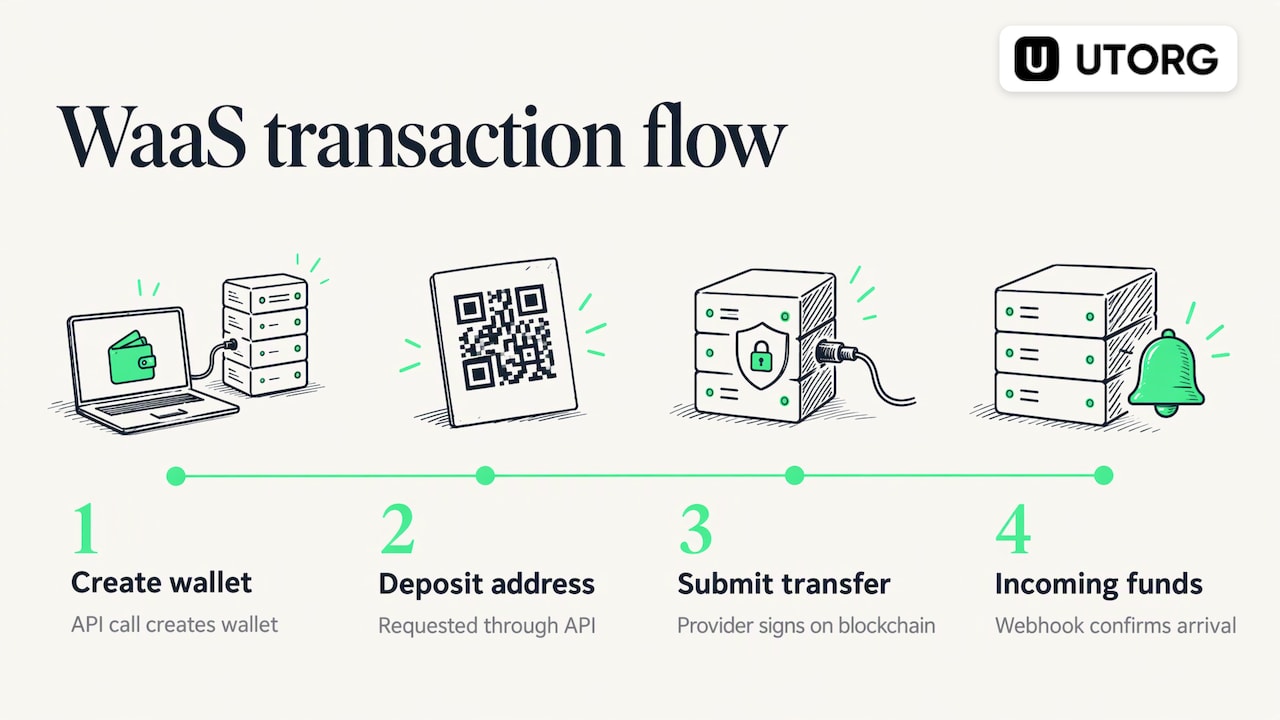
WaaS packages those jobs behind an interface. Your developers call an API to create a wallet for a new user, request a deposit address, submit a transfer and receive webhooks (automatic notifications) when funds arrive. The provider runs the cryptographic and blockchain layer underneath. Related terms such as “embedded wallet” and “wallet infrastructure API” describe the same idea: the wallet lives inside your app and carries your brand, and the user may never see a separate wallet product.
Build in-house or use WaaS
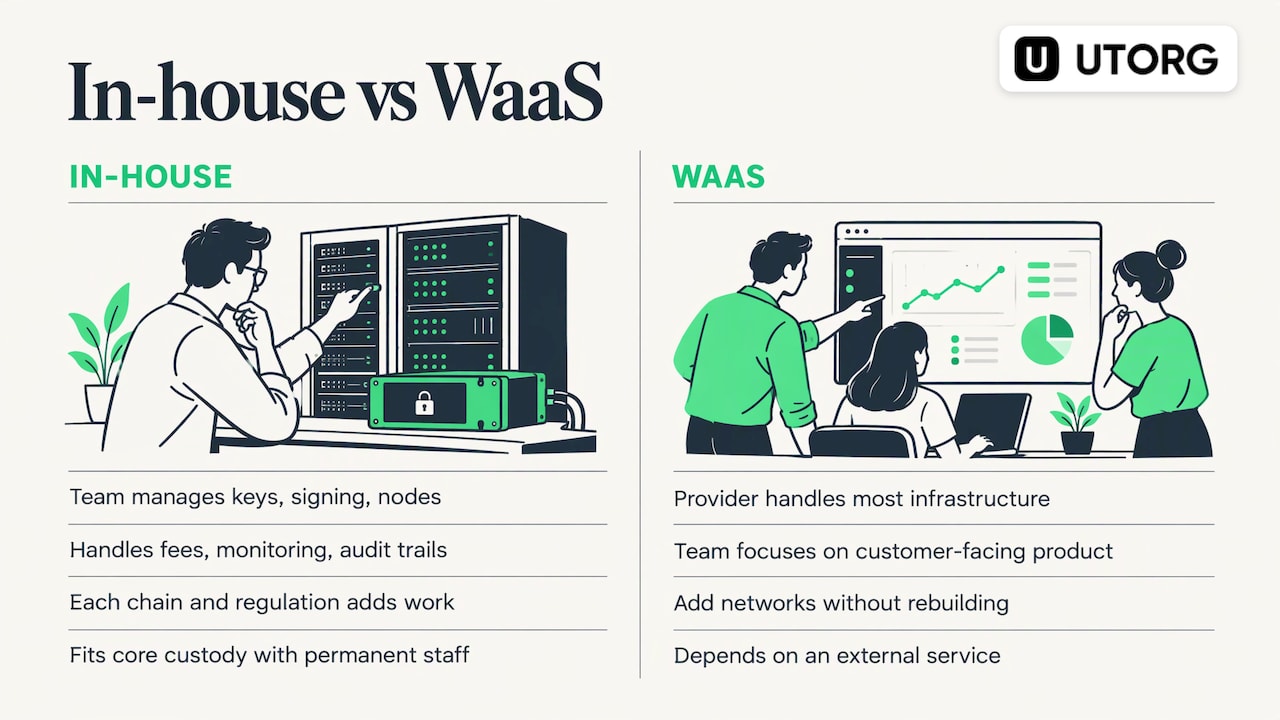
Building wallet infrastructure yourself means more than writing code. You need secure key storage, a signing process that survives staff turnover and attacks, node or RPC access for every chain you support, transaction fee handling, monitoring for failed or stuck transfers, audit trails and a security review process. Each new blockchain adds work, and each new regulation adds reporting.
Using WaaS moves most of that to a provider so your team spends its time on the product the customer sees: onboarding, balances, payments, rewards or payroll. The trade is dependence on an external service, which is why integration terms, data portability and service commitments matter in the evaluation below.
A useful rule: build in-house only if wallet custody itself is your core business and you can staff security, compliance and chain operations permanently. Otherwise, the speed to market and the ability to add networks without rebuilding favor an integrated platform. Utorg’s own explainer on embedded crypto wallet infrastructure walks through how the components fit together.
How the API connects wallets to your product
A typical integration follows a short sequence:
- Create the wallet. When a user registers, your backend calls the API and receives a wallet ID and addresses on the networks you support.
- Apply policies. You set rules such as transfer limits, allowlisted destination addresses or approval steps for large amounts.
- Fund it. The user deposits crypto or buys it with a card or bank transfer through an embedded on-ramp, the fiat-to-crypto conversion step.
- Move value. Transfers, swaps and payouts are submitted through the API and signed according to the custody model.
- Monitor and reconcile. Webhooks and transaction records feed your ledger, support tools and compliance reporting.
- Cash out or spend. An off-ramp converts crypto back to fiat, or a card lets users spend balances where cards are accepted.
Steps 3 and 6 are where many wallet projects stall. A wallet with no way in or out is a storage feature, not a product. Utorg offers embedded on- and off-ramps alongside its wallet architecture, so the funding and cash-out steps can sit in the same integration.
Custody models: who holds the keys
This is the decision with the most consequences. In practice, wallet providers offer three arrangements:
Academic work points the same way. A June 2025 peer-reviewed study in Electronics concludes that distributed key management should be combined with centralized authentication to remove single points of failure while keeping convenience for users. Regulators also write custody into their expectations: France’s financial markets authority, in its Instruction 2019-24, prefers multi-signature wallets requiring a quorum to sign and asks providers to formalize and audit key-generation and wallet-destruction procedures.
For the differences in plain terms, see Utorg’s guide to custodial and non-custodial wallets. Utorg’s consumer app, Utapp, uses the non-custodial approach: users keep control of their wallet keys while using a card for spending.
Questions to settle before you pick a model
- Do your users need to hold the keys, or do you want to manage them on their behalf?
- Which licenses or registrations does holding customer assets trigger in the countries where you operate?
- How will a user recover access, and who is accountable if recovery fails?
- Who approves outgoing transfers above a threshold, and can that approval be automated by policy?
Compliance: what follows the wallet
Wallet infrastructure does not remove your obligations. It changes who performs which task, so write down the split before launch.
United States. FinCEN’s 2019 guidance on convertible virtual currency consolidates how Bank Secrecy Act rules apply to business models that accept and transmit crypto. Depending on how your product handles customer funds, money transmitter obligations can apply, so confirm the classification of your model with qualified counsel.
United Kingdom. The Travel Rule took effect on 1 September 2023 under Regulation 64C of the Money Laundering Regulations 2017. According to the CryptoUK good practice guide, it requires FCA-registered crypto firms to collect, verify and share originator and beneficiary information for covered transfers, including those involving unhosted wallets. The rule follows the Financial Action Task Force’s 2019 extension of Recommendation 16 to virtual asset transfers.
France. The AMF instruction cited above requires digital-asset service providers to keep records of all activities for five years and prohibits custody of any other means of access to client digital assets.
The common thread across jurisdictions is identity verification (KYC), transaction monitoring (AML) and information sharing on transfers. Utorg’s guide to KYC and AML for crypto on-ramps lays out how these checks apply on the funding side. Utorg positions its solutions as designed for regulated environments.
What to assess in a WaaS provider
Use the same framework for every provider so the comparison stays consistent.
Two points deserve emphasis. First, ask about portability early, because it is rarely discussed in a sales process and is expensive to renegotiate later. Second, count the vendors needed to deliver the finished feature. A wallet vendor, an on-ramp vendor, a card issuer and a settlement partner mean four contracts and four reconciliation processes. Utorg lets you integrate individual components or combine them into a broader stack, with API and white-label options and stablecoin support across blockchains.
Use cases by business type
Gaming platforms. Players and studios want to move value instantly, and payouts to creators or players across borders are slow through traditional rails. Stablecoin wallets with global settlements address that need.
Banks and neobanks. A wallet inside the banking app lets customers buy, hold and send crypto without leaving the app. The on-ramp and the compliance workflow matter as much as the wallet.
Fintechs and payment providers. Wallets sit beside existing payment flows, so the API must reconcile cleanly with your ledger.
Web3 apps and wallet providers. Embedded purchases and card spending turn a wallet into something users can use every day. Utorg’s stablecoin cards and white-label crypto cards serve this case.
International businesses. Stablecoin settlement and cross-border payroll benefit from speed and from avoiding multi-step correspondent routes. A Bank of Canada paper comparing payment arrangements finds that some stablecoin arrangements can speed up cross-border payments and give users more privacy control, while serving niche use cases rather than replacing traditional systems. That framing helps set scope: start with the corridors and payment types where speed matters most. Utorg explains the mechanics in its guide to cross-border crypto payments.
Security habits that apply on both sides
Whether you build or buy, wallet security rests on a few disciplines: separated roles for creating and approving transfers, limits and allowlists, logging that cannot be altered by the people it records, and clear incident procedures. Your end users have their own part, from protecting recovery phrases to avoiding phishing links. Utorg’s wallet security checklist is a practical reference you can adapt for user education inside your product.
Where Utorg fits
Utorg provides crypto infrastructure for businesses: embedded fiat on- and off-ramps, wallet infrastructure, stablecoin settlements and branded crypto-card programs, delivered through APIs and white-label solutions. Partners add crypto functions, onboard users and move funds internationally without building the full infrastructure themselves, and can take one service or several.
To see how the wallet layer is structured, start with the wallet infrastructure page. If you are building a funding flow first, review the embedded on- and off-ramps. For individuals, Utapp by Utorg combines a self-custody wallet with a crypto card for buying, holding, swapping and sending crypto, with USDC earning through Earn; see the Utorg app.
Frequently Asked Questions
FAQ title
What is wallet as a service?
It is a managed platform that lets a business create and operate crypto wallets for its users through an API or SDK. The provider handles key management, signing and blockchain connectivity, while the business controls the user experience and branding.
Is an embedded wallet API the same as WaaS?
In practice the terms overlap. An embedded wallet API is the interface through which WaaS is delivered: your app calls it to create wallets, read balances and submit transfers inside your own product.
Who controls the keys in a WaaS setup?
It depends on the model. Keys can be held by the platform (custodial), by the user (non-custodial) or split between parties. Choose the model that matches your licensing position and what you promise users. Utorg’s guide to custodial and non-custodial wallets explains each.
Does using WaaS remove my compliance duties?
No. KYC, AML and Travel Rule obligations depend on your activity and jurisdiction. Divide the tasks between you and the provider in writing, and confirm your classification with qualified legal counsel.
What else do I need besides a wallet?
Most products also need a way to fund wallets with fiat, a way to cash out, and often stablecoin settlement or card spending. Combining these in one stack reduces the number of integrations to maintain.
- Comparative Analysis of Security Features and Risks in e-wallets and crypto wallets (MDPI Electronics, June 2025)
- AMF Instruction DOC-2019-24, cybersecurity (April 2021)
- FinCEN Guidance FIN-2019-G001 (May 2019)
- CryptoUK Travel Rule Good Practice Guide (May 2024)
- The Relative Benefits and Risks of Stablecoins as a Means of Payment (Bank of Canada, 2022)