Crypto Exchange API Integration: A Practical Guide for Businesses

Read time 9 min
TL;DR
- “Exchange API” covers three different things: market data, trading, and fiat-to-crypto conversion with settlement. Pick the one that matches your product before writing code.
- Keep API keys and signing on your backend only, scope them to the minimum permissions, and design for retries, rate limits and idempotent requests.
- Handling customer funds can trigger licensing and AML duties. In the US, FinCEN treats certain crypto business models as money transmission.
- If your users need to buy, hold, send or settle crypto, an embedded on/off-ramp, wallet infrastructure and stablecoin settlement layer is a shorter path than integrating a raw trading API.
- Utorg offers these components individually or combined, through APIs and white-label deployments.
Integrating a crypto exchange API means connecting your product to a system that can quote prices, accept orders, hold balances and move funds. For most fintechs, banks, wallets and gaming platforms, the real goal is narrower: let users buy crypto with fiat, hold it, and cash out or settle, without building trading, custody and compliance operations from scratch. That goal is best met with an embedded on/off-ramp and wallet layer, and Utorg provides embedded on/off-ramps through APIs and white-label options, so you integrate the function your users need instead of the whole exchange stack.
This guide explains what “exchange API” can mean, how a sound integration is built, where projects go wrong, and how to decide which layer to connect.
What “crypto exchange API” actually means
The phrase is used loosely, and search results mix several products. Before you scope an integration, separate them.
A trading API is built for people who trade. A product that sells crypto to its own customers has a different set of problems: who verifies the buyer, which cards and bank transfers are accepted, what happens when a payment fails, and where the funds land. Those are on/off-ramp and wallet problems, and they decide whether users finish a purchase.
How a sound integration is structured
Whichever layer you connect, the architecture follows the same pattern.
Keep the integration on the backend
API credentials belong on your server. If calls are made from a browser or mobile client, anyone can extract the keys and act with your permissions. Your frontend should talk to your own backend, which then talks to the provider. This also gives you one place to log requests, enforce limits per user and swap providers later without changing the app.
Authenticate and sign requests properly
Most financial APIs use a key plus a secret used to sign each request, often with a timestamp so a captured request cannot be replayed later. Store secrets in a managed secrets vault, not in source control or environment files shared across teams. Rotate them on a schedule and immediately after any staff change that touched them.
Scope permissions to the minimum
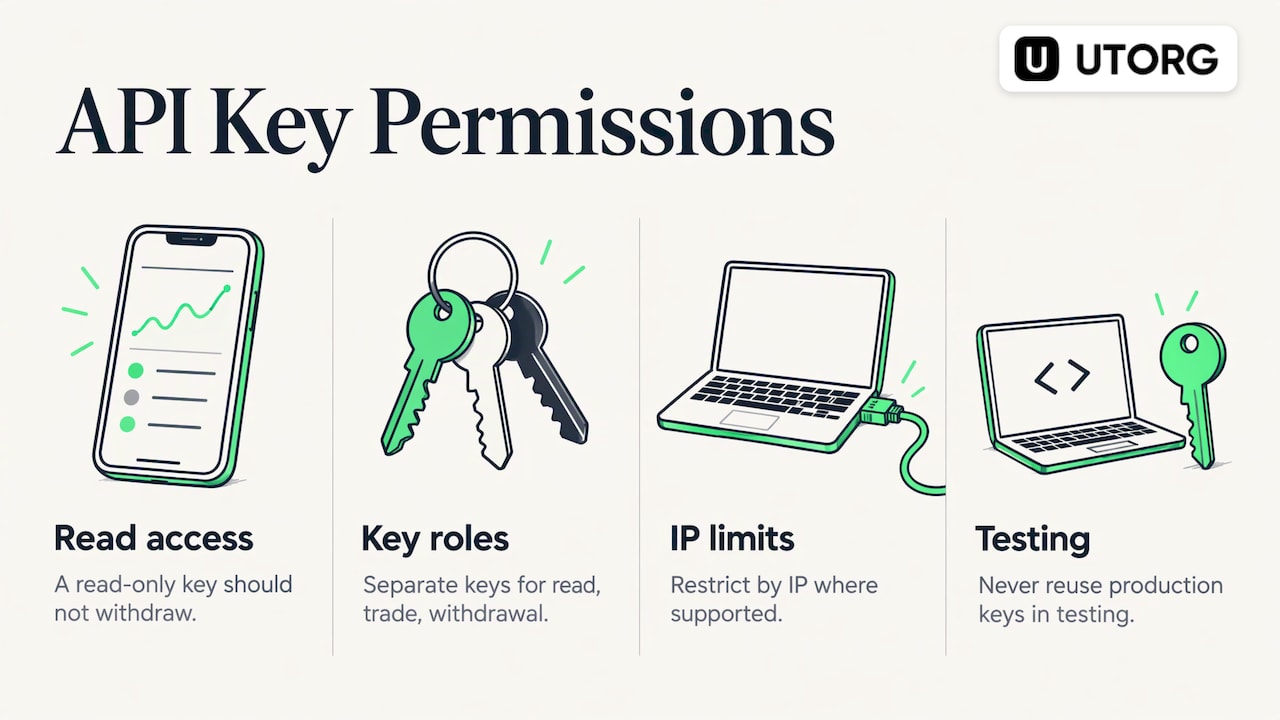
If a key only needs to read balances, it should not be able to withdraw. Separate keys for read, trade and withdrawal, restrict by IP address where the provider allows it, and never reuse a production key in testing. The OWASP API Security Top 10 lists broken authorization and unrestricted resource consumption among the most common API risks, and both apply directly to a crypto integration.
Design for failure
Payment and blockchain flows are asynchronous. A purchase moves through created, pending, completed or failed states, and a transfer can sit unconfirmed for minutes. Build around that:
- Use webhooks or callbacks for status changes, and verify their signatures.
- Make requests idempotent, so a retried call after a timeout does not create a second order.
- Respect rate limits with backoff, and queue non-urgent calls.
- Reconcile your ledger against the provider’s records on a fixed schedule, not only when a customer complains.
Keep your own ledger
Treat the provider’s response as an input to your ledger, never as the ledger. You need your own record of what each user was promised, what was paid, and what was delivered, with the quote, fee and rate captured at the time of the order. That record is what support, finance and auditors will rely on.
The step-by-step plan
- Define the user outcome. Write it in one sentence: “A user pays with a card and receives USDC in their in-app wallet,” or “our platform pays contractors in 40 countries.” The sentence picks the API layer.
- Map the regions and payment methods. Coverage differs by country, currency and payment rail. List where your users are and how they pay before you evaluate providers.
- Decide who holds what. Settle whether funds and keys sit with the user, with you, or with a provider. This decision drives your licensing exposure, your security burden and your product design.
- Check the regulatory position. Get legal advice on whether your model counts as money transmission or a virtual asset service in each market you serve (see the compliance section below).
- Build in a sandbox. Integrate the quote, order, status and webhook flow against test endpoints, including failure cases: declined payment, expired quote, failed identity check, unconfirmed transfer.
- Wire in monitoring. Track success rate per payment method and region, time to completion, and drop-off at each step. A conversion problem usually shows up as a single weak step.
- Run a limited launch. Release to a small group, compare your ledger to the provider’s reports, then widen access.
With an embedded on/off-ramp, steps 2, 3 and 5 are shorter, because the provider operates the conversion flow and supports the payment methods, so your team builds the experience around it rather than the plumbing underneath. Utorg’s on-ramp guide walks through the conversion flow your users will go through.
Compliance: what the integration does not remove
The technical work is usually the smaller part. Once your product touches customer funds, regulation follows.
In the United States, FinCEN’s 2019 guidance on convertible virtual currency explains how the Bank Secrecy Act applies to different business models, and it treats certain administrators and exchangers of virtual currency as money transmitters. Whether your own product falls into that category depends on how funds and keys are handled, so this is a question for a qualified lawyer before launch, not a detail to settle after.
Internationally, the Financial Action Task Force sets the standards that most countries follow for virtual assets and their service providers, including customer due diligence and the “travel rule,” which requires identifying information to accompany certain transfers. Practically, your integration needs to support:
- KYC (know your customer): verifying the identity of buyers before they transact.
- AML (anti-money-laundering) monitoring: screening transactions and wallets and reporting suspicious activity.
- Sanctions screening: blocking restricted users and destinations.
- Record keeping: keeping orders, identity checks and transfers retrievable.
This is the main reason many businesses choose a provider built for regulated environments rather than assembling these controls around a trading API. Utorg positions its infrastructure as designed for regulated environments, with stablecoin support across blockchains.
Build on a trading API or embed a ramp?
Use these criteria.
If your answers sit mostly in the right-hand column, a raw exchange API means building a payments business around a trading engine. A purpose-built layer lets you spend the engineering time on your product.
Worked example: a gaming platform with instant payouts
A gaming platform wants players to cash out winnings in USDC and wants to fund operator payouts across borders.
- With a trading API: the team opens exchange accounts, builds KYC and payment handling, manages withdrawal addresses, monitors transactions, and handles failed or delayed transfers. Each country adds work.
- With an embedded layer: the team uses a wallet API for player balances, an off-ramp for cash-out, and stablecoin settlement for cross-border flows. The integration points are three: wallet, ramp, settlement.
The second path is how Utorg’s global settlements and wallet components are designed to be used: separately or combined into one offering. The same pattern applies to a neobank adding crypto purchases, a payment provider offering stablecoin payouts, or an international business running cross-border payroll.
Wallet infrastructure: where the funds live
An on-ramp delivers crypto somewhere, and that destination shapes the whole product. Options include a user-held wallet, a wallet your platform operates, or a combination. Each choice changes how recovery works, how much security responsibility you carry and what you must disclose to users.
Embedded wallet infrastructure lets users hold and move assets inside your app without installing anything separate. Utorg covers this in its wallet infrastructure API and in a guide to embedded crypto wallet infrastructure for apps, fintechs and Web3 platforms. If your product will also hold users’ keys in some form, read the wallet security checklist before you design the key flow.
Cards: turning balances into spending
For products where users should spend crypto balances in daily life, a card programme closes the loop. Utorg offers stablecoin cards and white-label crypto cards, so a bank, wallet or fintech can issue a branded card on top of its own wallet offering. Issuance and maintenance fees apply to the card programme; the details are on the stablecoin cards page.
Common mistakes in exchange API projects
- Calling the API from the client app. This exposes credentials. Always route through your backend.
- Assuming one success path. Most support tickets come from pending payments, expired quotes and unconfirmed transfers, not from the happy path.
- Ignoring fees in the user experience. Show the quote, network fee and total before the user confirms. A mismatch between the quoted and delivered amount erodes trust quickly.
- Leaving compliance for later. Identity checks and monitoring shape the user flow, so adding them after launch means rebuilding screens.
- Locking into one coverage footprint. Choose an architecture where you can add payment methods, regions or chains without reworking your ledger.
- No reconciliation. Without a scheduled comparison against the provider’s records, small mismatches grow into large ones.
How Utorg fits
Utorg provides crypto infrastructure for businesses: embedded fiat on- and off-ramps, wallet infrastructure, stablecoin settlements and branded crypto-card programmes. Partners integrate individual services or combine them into a broader wallet and payments offering, through APIs and white-label solutions, and move funds internationally without building the full infrastructure themselves.
The starting point is the embedded on/off-ramp page, which describes the conversion layer, and the Utorg site for the wider stack of wallet architecture and white-label cards.
Before you commit to a design, use the on-ramp provider checklist to compare coverage, payment methods and onboarding on the criteria that matter for your users.
If you are an individual rather than a business
This guide is written for teams integrating crypto into a product. If you are a person who wants to buy, hold, swap and spend crypto, Utapp by Utorg is a consumer app that combines a self-custody wallet with a crypto card, and it lets you earn on USDC through Earn. You keep control of your wallet keys. You can start on the Utorg personal page or buy crypto directly.

Frequently Asked Questions
FAQ title
What is a crypto exchange API?
It is an interface that lets software talk to a crypto trading venue or service: reading prices, placing orders, checking balances or moving funds. Depending on the provider, it can mean market data, trading, or fiat conversion and settlement. Decide which of these your product needs first.
Do I need a trading API to let my users buy crypto?
Usually not. Letting users buy crypto with a card or bank transfer is an on/off-ramp function, which includes payment methods and identity checks. An embedded on/off-ramp provides that flow through an API or white-label setup, so you do not have to build order handling and payments yourself.
Is it safe to put API keys in my mobile app or website?
No. Keys in a client app can be extracted and used with your permissions. Keep them on your backend, scope each key to the narrowest permission it needs, and rotate them on a schedule.
Does integrating an API make me a regulated business?
Not automatically, but handling customer funds or keys can bring licensing and AML obligations. In the US, FinCEN’s 2019 guidance describes how money transmission rules apply to virtual currency models. Ask a qualified lawyer about your specific structure before launch.
Can I combine a wallet, an on-ramp and a card?
Yes. Utorg’s components can be integrated individually or combined into a broader wallet and payments offering, so you can start with one service and add others as your product grows.