Stablecoin Payment Infrastructure: Layers, Costs, Risks


Read time 9 min
TL;DR
- Stablecoin payment infrastructure has five layers: on-ramp, wallet, settlement network, off-ramp or card, and compliance with reconciliation. Weakness in any one limits the whole flow.
- Speed and cost gains depend heavily on the quality of the conversion points at each end, according to the BIS.
- Payments are still a small share of stablecoin activity, which is why integrating a ready-made stack beats building every layer yourself.
- Rules are converging on 1:1 reserves and par redemption, but the US GENIUS Act and UK regime are still phasing in, so check the rules for each market you serve.
- Utorg’s global settlements are listed at €0.02 to €0.20 per transaction, one-off, and stablecoin card issuance carries a €0 one-off fee.
Stablecoin payment infrastructure is the set of components that lets a business or a consumer receive fiat, convert it into a stablecoin, hold it in a wallet, move it across a blockchain and convert it back to local currency or spend it. The token is the easy part. The value, and the risk, sit in the ramps, wallets, compliance controls and reconciliation around it. If you run a platform, bank, fintech or international payroll, you can integrate these layers separately or as one stack. Utorg offers embedded on- and off-ramps, wallet infrastructure, stablecoin settlements and card programs for exactly that purpose.
What stablecoin payment infrastructure actually is
The European Central Bank’s Crypto-Assets Task Force describes stablecoins as digital units of value that rely on stabilisation tools to limit price swings against reference currencies. Some hold collateral. Others use a mechanism that tries to match supply and demand. For payments, the practical category is the fiat-referenced token, usually a dollar one such as USDC.
Infrastructure is everything that makes such a token usable by someone who does not want to think about blockchains. A payer has dollars in a bank account. A payee wants local currency, or a card balance, or a wallet they control. Between those two points sit conversion, custody, transfer, screening and bookkeeping.
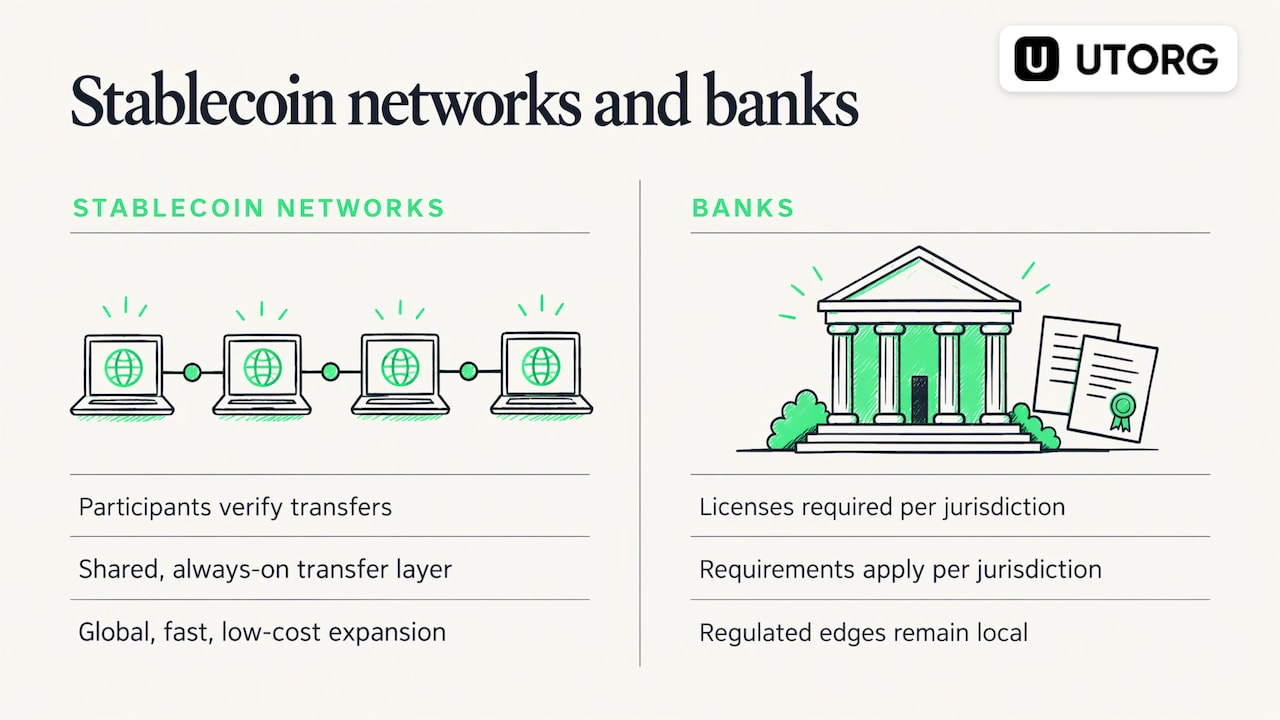
How does that differ from ordinary payment infrastructure? The Bank of Japan’s Director-General Takeda explained in July 2025 that stablecoin transfers are verified by network participants using encryption keys and a consensus algorithm, not by the issuer. As a result, networks built on stablecoins can expand globally and quickly at low cost, whereas banks must obtain licenses and meet requirements in each jurisdiction. That is the structural difference: the transfer layer is shared and always on, while the regulated edges remain local.
The five layers of a stablecoin payment flow
Every working flow, whether it pays a freelancer in Buenos Aires or settles a gaming payout, passes through the same layers. Knowing them tells you what to buy, what to build and where a vendor’s pitch is thin.
1. The on-ramp
The on-ramp converts fiat into a stablecoin. It involves a payment method (card, bank transfer, SEPA in Europe, ACH or wire in the US), identity checks (KYC, meaning know your customer, and AML, anti-money-laundering screening) and a price that includes spread, the gap between the quoted and market rate. Embedded on-ramps place this inside your own app so users never leave it. That is the service behind Utorg’s embedded on/off-ramps.
2. The wallet
A wallet holds the stablecoin and signs transfers. For a business, wallet infrastructure means creating and managing wallets for many users or counterparties through an API, with permissions, limits and recovery handled at the architecture level. Utorg describes this as enterprise-grade wallet architecture that partners can integrate on its own or combine with other components.
3. The settlement network
This is the blockchain that moves the token. Choices include which networks you support and which stablecoins you accept on each. Utorg’s positioning is stablecoin support across blockchains, which matters because your counterparties will not all hold the same token on the same chain.
4. The off-ramp or spend layer
Value has to leave the stablecoin world somewhere: a bank payout in local currency, a card payment at a merchant, or a transfer to another wallet. Card programs are the most direct version. Utorg’s stablecoin cards let businesses give users a way to spend USDC, and the issuance fee listed there is €0 one-off.
5. Compliance and reconciliation
Every transfer needs screening, records and a match against your ledger. Finance teams care most about this layer: a payment that settles in seconds but cannot be matched to an invoice still costs hours of manual work. Ask early how transaction identifiers, statuses and fees are exposed through the API.
Speed, availability and cost: what the evidence shows
The case for stablecoin rails rests on three claims: speed, uptime and cost. Here is what official and professional sources say.
- Speed. The Bank for International Settlements (BIS) notes that current correspondent-banking settlement times range from under five minutes to more than two days, and that fewer links in the chain could reduce settlement risk, fees and funding needs.
- Uptime. McKinsey reports that stablecoin-based payments are typically nearly instant, lower cost and available almost 100 percent of the year, and that wallet-based infrastructure widens access compared with account-based systems.
- Scale. The same McKinsey piece says stablecoin circulation doubled over 18 months and facilitates about $30 billion of transactions daily, still under 1 percent of global money flows. There is room to grow, and early integrators set the pace.
The BIS also makes a point that decides whether a project succeeds. The smaller a stablecoin ecosystem, or the fewer legs of a payment that use a stablecoin, the more users rely on conversion services to and from sovereign currency, and the higher the costs. In practice, the quality of your on- and off-ramps in each country sets your real cost and speed. A fast chain does not help if the payout leg takes two days.
A worked cost example
Suppose a platform pays 1,000 contractors once a month. On a stablecoin settlement rail priced per transaction at the €0.02 to €0.20 range that Utorg lists for global settlements, the network-side charge for those 1,000 payouts falls between €20 and €200 for the month. Compare that line item with what you currently pay in wire or correspondent fees, and add the conversion spread on each end, because that is where most of the total sits. Use your own volumes and corridors when you model it, and ask for the spread on the specific currency pair.
Where businesses and consumers use it
The Kansas City Fed’s April 2026 research briefing finds that payments are still under 1 percent of all stablecoin use. It lists the main payment use cases: peer-to-peer transfers and remittances, consumer-to-business payments including stablecoin credit and debit cards, business-to-business cross-border supplier payments, and business-to-consumer payments such as payroll.
The Federal Reserve’s Payments Innovation Conference gives concrete cases. Panelists described savings dollarization in Colombia, cross-border spending for Mexican border residents and a backend engineer in Buenos Aires paid by a European or US employer, with locally licensed e-money providers partnering with a crypto entity to run the flow. The Bank of England likewise expects stablecoins to support person-to-person transfers, merchant payments, online purchases and cross-border payments.
Here is how that maps to the readers who ask about this most:
Integrate components or take the whole stack
Most teams do not need everything at once. A neobank may need only an embedded on-ramp. A gaming platform may need settlement and payouts first and cards later. Utorg’s approach is to let partners integrate individual services through APIs and white-label options, or combine them into a broader wallet and payments offering.
Building every layer yourself means separate vendors for conversion, custody, screening and card issuing, each with its own contract, uptime and reporting format. A single integration reduces the number of places where a payment can stall and the number of reconciliation formats your finance team must map.
What to evaluate before you integrate
Use this checklist when you compare any stablecoin infrastructure offering, ours included.
Finance and compliance should review the table together. A pricing quote that bundles spread into the exchange rate is harder to compare than one that separates each fee, so ask for each component.
Risks to assess, and how rules are changing
Reserve and redemption risk
The Bank of Canada’s staff analysis describes run risk: if holders doubt that a token can be redeemed at par, a rush to redeem can force the issuer to sell reserves at a discount. Illiquid reserves and weak disclosure about composition, safeguarding and redemption terms make this worse. The practical step is to hold and settle in tokens whose issuers publish reserve details and offer clear redemption, and to avoid unregulated tokens whose backing claims you cannot verify.
Regulatory status
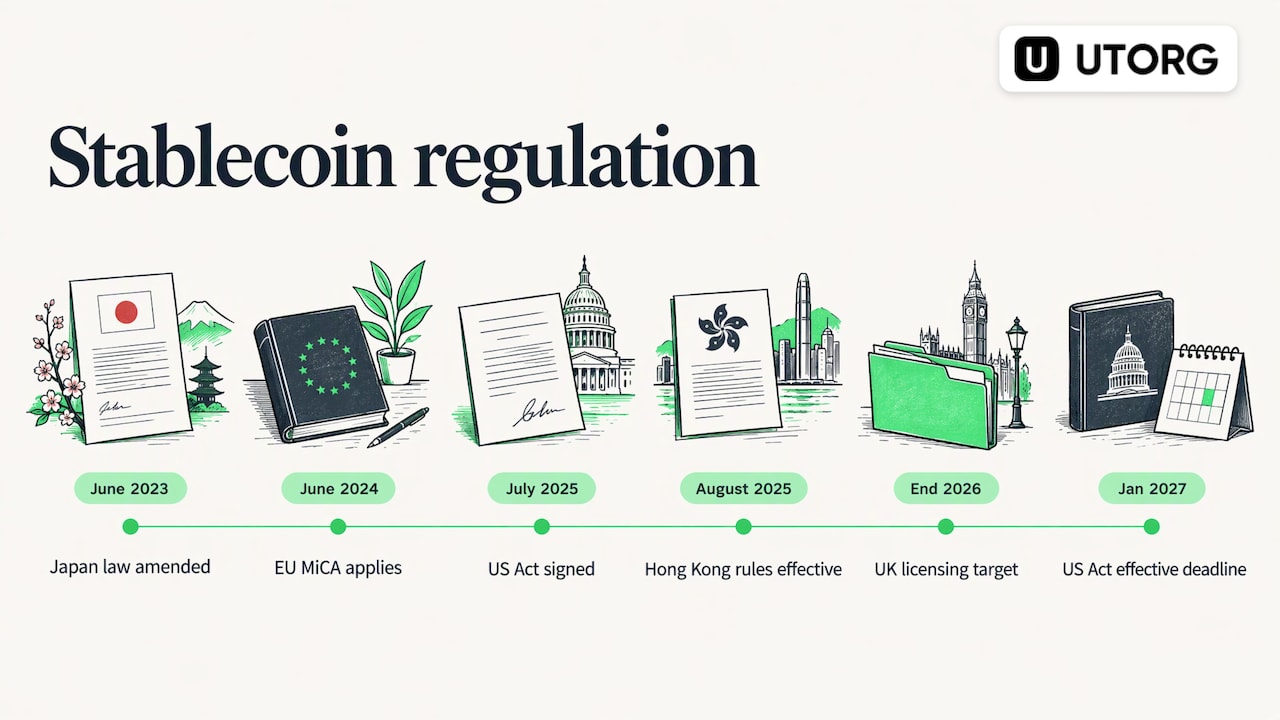
A January 2026 paper from the International Capital Market Association records the timeline: the EU’s MiCA rules for stablecoin issuers applied from June 2024, Hong Kong’s Stablecoins Ordinance took effect in August 2025, Japan amended its payment law in June 2023, and the US GENIUS Act was signed in July 2025 and takes effect no later than January 2027. The UK aims for a licensing regime by the end of 2026. The same paper finds the frameworks converge on 1:1 backing with liquid, low-risk assets, segregated third-party custody and redemption at par.
For US teams, Gibson Dunn’s March 2026 guide notes that the GENIUS Act was signed on 18 July 2025 and that Treasury and OCC rulemakings are underway, with further proposals expected from the Federal Reserve, FDIC and FinCEN. Because the details are still arriving, confirm your obligations with your counsel and the relevant regulator, and pick infrastructure built for regulated environments, which is how Utorg positions its stack.
Operational risk
Operational failure is usually less dramatic: a chain congests, a payout partner closes for a holiday, a transfer goes to the wrong network. Support for multiple blockchains, clear transaction statuses and tested retry logic matter more here than headline speed.
How Utorg fits
Utorg provides crypto infrastructure for businesses: embedded fiat on- and off-ramps, wallet infrastructure, stablecoin settlements and white-label branded crypto card programs, delivered through APIs. Partners can add crypto functionality to their products, onboard users and move funds internationally without building the full infrastructure themselves.
Two published figures help with planning. Global settlements are listed at €0.02 to €0.20 one-off per transaction. Stablecoin cards carry a €0 one-off issuance fee. Other services, including the embedded ramps and wallet architecture, have no published price, so the route to a quote is sales.
If you want to scope a pilot, start with the layer that currently slows your payments: ramps for user onboarding, settlement for payouts, or cards for spending. Our blockchain infrastructure guides explain the underlying concepts in more depth.
For individuals: the same rails in an app
The consumer side of this infrastructure is a wallet plus a way to spend. Utapp by Utorg combines a self-custody wallet, where users keep control of their private keys, with a crypto card. Users can buy, hold, swap and send crypto, earn on USDC through Earn, and use the card for everyday spending where supported. That suits freelancers paid in crypto, travelers and expats who spend across borders, and USDC holders with idle balances. See the Utorg app and wallet or the Utorg Card for details, and buy crypto to get started.
Frequently Asked Questions
FAQ title
How does a stablecoin payment company make money?
Typically through a mix of per-transaction fees, spread on currency conversion, and card-related fees such as issuance or maintenance. Because the revenue sits in several places, compare the fee for each component rather than a single headline price.
Is stablecoin payment infrastructure the same as a crypto exchange?
No. An exchange is a trading venue. Payment infrastructure is the set of ramps, wallets, settlement and compliance tools that lets another business send, receive and spend stablecoins inside its own product, often under its own brand.
Are stablecoin payments instant?
The blockchain transfer is typically near-instant, as McKinsey notes. End-to-end speed also depends on the on-ramp and off-ramp at each end, so confirm payout times in each country you serve.
Do I need to build my own wallets?
Not necessarily. Wallet infrastructure can be integrated through an API, with individual components taken on their own or combined into a wider offering.
- ECB Crypto-Assets Task Force: Stablecoins, implications for monetary policy and financial stability
- Bank of Japan: Speech by Director-General Takeda on payment and settlement
- BIS CPMI: Considerations for the use of stablecoin arrangements in cross-border payments
- McKinsey: Stablecoins payments infrastructure for modern finance
- Kansas City Fed: What Are Stablecoins Used for Today?
- Federal Reserve: Payments Innovation Conference stablecoin panel transcript
- Bank of England: Sterling-denominated systemic stablecoins
- Bank of Canada: Potential benefits and key risks of fiat-referenced stablecoins
- ICMA: The Stablecoin question, January 2026
- Gibson Dunn: Global stablecoin rules in focus, March 2026