White Label Crypto Card: How a Branded Program Works


Read time 9 min
TL;DR
- A branded crypto card program puts your logo on a card, while a licensed issuer, a card network and a conversion layer do the regulated work behind it.
- At checkout the merchant is paid in fiat. Crypto is sold before settlement, so the real cost sits in the spread between the market price and the issuer’s sale price, not only in listed fees.
- Branding a card does not move responsibility. Supervisors in the EU and UK expect the regulated party to stay accountable for partner conduct and customer disclosures.
- Utorg’s published terms for stablecoin cards list a 0 EUR one-off issuance fee. Maintenance fees have no published price, so ask sales for them.
- If you are a consumer who wants to spend crypto rather than launch a program, Utapp pairs a self-custody wallet with a card.
A white label crypto card is a payment card that carries your brand but runs on someone else’s issuing, wallet and conversion infrastructure. Your customers fund it with crypto or stablecoins, and the card network settles every purchase in fiat. To launch one, you need to settle four things: who holds the licenses, how crypto is converted at the point of sale, who answers to the customer and the regulator, and what the program costs once the spread is counted. Utorg offers white-label crypto cards and stablecoin cards as one part of a wider crypto infrastructure stack, and this guide covers the questions to work through whichever route you take.
What a white label crypto card is
In payments, “white label” means the product is built by one company and sold under another’s name. A branded crypto card program applies that idea to cards. You choose the design, name, app experience, limits and customer relationship. The provider supplies the parts you would otherwise have to license, build and certify yourself.
Three terms come up in every conversation:
- Issuer: the regulated institution that issues the card under a card network license (Visa or Mastercard). It is the party the network and regulators hold responsible.
- BIN sponsor: the issuer that lends its bank identification number range, the first digits of a card number, to a program that is not itself a licensed issuer.
- Program manager: the business that runs the card program day to day: branding, onboarding, support, pricing. In a white-label setup, that is you.
The crypto part is what makes the card different from an ordinary branded debit card. Cardholders hold digital assets, usually stablecoins such as USDC, and something has to turn those assets into fiat at the moment of payment.
How a crypto card payment works
Most merchants do not accept crypto, and the card networks move fiat. Mastercard describes the mechanism in its explainer on crypto cards: the crypto is converted to fiat outside the payment network before settlement. On a debit-style card, the issuer instantly sells the equivalent crypto from the connected wallet, the fiat crosses the network to the merchant within seconds, and the merchant never learns that crypto funded the purchase.
In sequence, a typical purchase looks like this:
- The cardholder taps or enters the card at a merchant.
- The merchant’s bank sends an authorization request over the card network to the issuer.
- The program checks the cardholder’s available balance and applies limits, fraud rules and sanctions screening.
- If the balance covers the amount, the authorization is approved and the amount is held.
- The crypto or stablecoin equivalent is sold or debited from the cardholder’s balance.
- The issuer settles in fiat with the merchant’s bank through the network.
The order of steps 4 and 5 differs between programs. Some convert at authorization, some at settlement, some at both, and some hold a stablecoin balance that is already denominated in dollars. That design choice affects declines, refunds and how much price movement a cardholder is exposed to, so it belongs on your specification list.
Where the cost really sits
Mastercard also points out the cost that catches new cardholders off guard. Because the card sells an asset to fund each purchase, the spread, meaning the gap between the market price and the price at which the issuer sells, can act as a hidden cost even when a card advertises zero transaction fees.
For a program owner, effective cost per cardholder is easier to reason about as a formula:
Effective cost = issuance fee + maintenance fees + network and FX charges + spread on conversion + on-/off-ramp fees on funding and withdrawals
When you compare providers, ask for each term of that formula in writing. A low headline fee with a wide conversion spread can cost your users more than a visible fee would. Stablecoin-funded cards narrow the spread problem because there is less price movement between funding and spending, which is one reason many programs are built around USDC.
On Utorg’s stablecoin cards page, the issuance fee is published as 0 EUR one-off. Maintenance fees carry no published figure, and the same is true of most card pricing: it is agreed per program. For settlement flows around the card, Utorg’s global settlements are listed at 0.02-0.20 EUR one-off per transaction.
The stack behind a branded program
A working program joins several layers. Building each yourself takes licenses, certification and a long integration queue, which is why most businesses buy the stack as a bundle or assemble it from parts.
Utorg’s infrastructure covers several of these layers: embedded on- and off-ramps, wallet infrastructure, stablecoin settlement and white-label crypto cards. Businesses can integrate individual services or combine them into a broader wallet and payments offering, through APIs and white-label solutions. A practical benefit of one stack is fewer handoffs: a card, a wallet and a funding route that were built to work together create fewer places for a payment to stall.
Who a branded card suits
The use cases differ by who you serve.
Gaming platforms. Players and creators want winnings or earnings available quickly. A branded card lets a platform pay out in stablecoins and let users spend them immediately, with settlement handled behind the scenes.
Banks and neobanks. A crypto-funded card adds a spending feature to an existing customer base without the bank building conversion and custody from scratch.
Fintechs and payment providers. A branded card extends a product line and keeps the customer relationship, the data and the interface under your own name.
Wallet providers and Web3 apps. Users who already hold assets in your app often want to spend them. A card closes the gap between holding and paying. Utorg has described one such arrangement in its post on crypto-to-card spending for 2M+ Wirex users.
International businesses. Companies with contractors or staff in several countries can pair stablecoin settlements with cards, so payees spend a balance in local shops without waiting for a bank transfer. Payroll across borders is covered by Utorg’s settlement API.
What to assess before you launch
A branded program is a regulated product with your name on it. These are the areas where programs tend to succeed or struggle.
Responsibility and customer communication
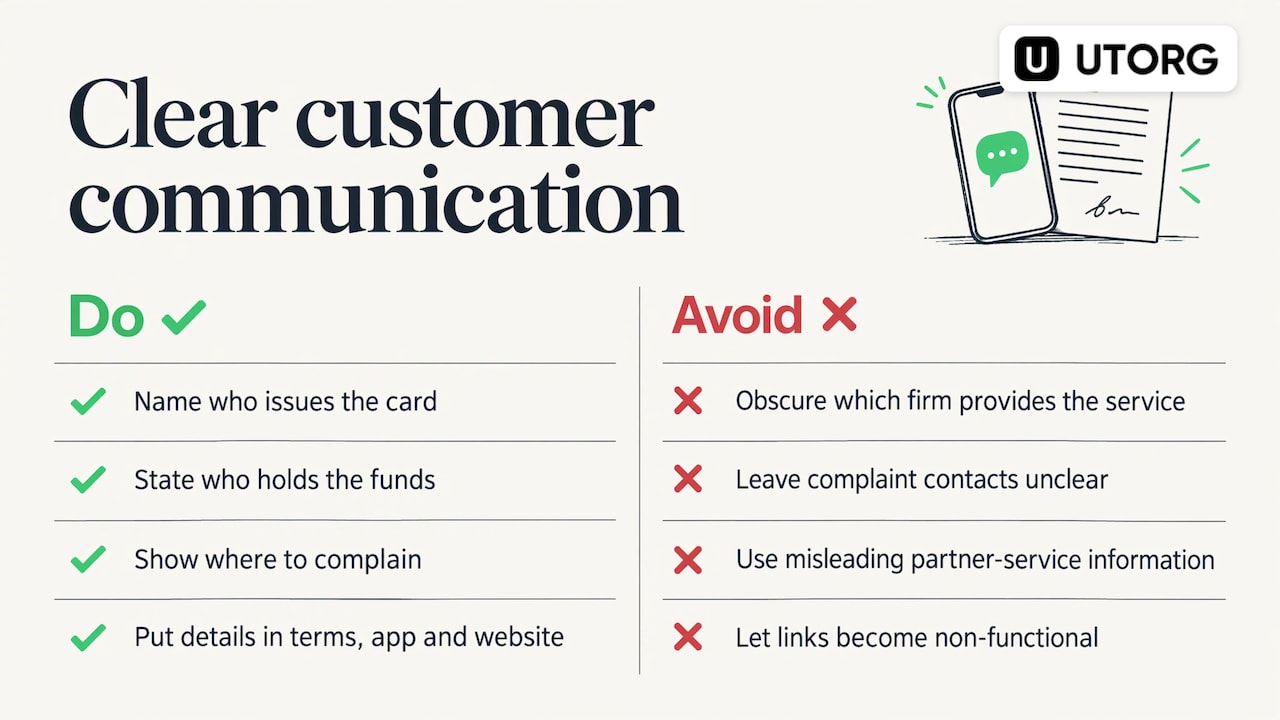
The European Banking Authority’s October 2025 report on white labelling of financial services says the arrangement can obscure which firm provides a service and whom consumers should contact with a complaint. It also warns that unclear allocation of responsibilities and weak consumer information can raise fraud risk and impair informed choice.
The practical response is simple: put a clear statement of who issues the card, who holds the funds and where to complain in your terms, your app and your website. Lithuania’s central bank reported in a 2025 supervisory letter that its 2024 review found misleading or inaccurate partner-service website information, and non-functional links, in some white-label arrangements. The same letter says regulated payment and e-money institutions stay responsible for compliance when white-label partners act for them. Branding a service does not transfer the obligation.
Regulation by market
Rules differ by country, so write the program’s scope country by country.
- United States. The GENIUS Act (Public Law 119-27), enacted in 2025, makes it unlawful for anyone other than a permitted payment stablecoin issuer to issue a payment stablecoin, and requires permitted issuers to hold identifiable reserves backing outstanding tokens at least one-to-one, within the Act’s specified reserve categories. A card program that accepts stablecoins as funding should know which stablecoin issuers it relies on and whether they are permitted issuers.
- United Kingdom. The FCA’s 2025 feedback statement FS25/1 says card issuers remain responsible for Strong Customer Authentication compliance and, under the Payment Services Regulations 2017, for reimbursing unauthorized transactions, including those made through digital wallets.
- European Union. A law firm’s summary of the EBA’s February 2026 opinion on stablecoin payments says some e-money token transactions may qualify as payment services under PSD2, and that relevant crypto-asset service providers may need PSD2 authorization once the transition period ends. Confirm with counsel which side of that line your flows fall on.
Utorg describes its infrastructure as designed for regulated environments. Whatever stack you choose, have a lawyer in each target market review the program before launch.
Security and uptime
Cards that live in digital wallets bring their own risks. The FCA notes that wallet outages can temporarily stop users paying, and that social engineering and phishing can capture credentials so that a victim’s card is loaded into a fraudster’s wallet. Plan for both: provisioning checks, step-up authentication, and a card-freeze control that works instantly from your app.
Product and operations checklist
- Card types and regions: virtual, physical, both; countries where cardholders can be onboarded.
- Funding assets and chains: which stablecoins and networks fund the card.
- Conversion timing: authorization, settlement or both, and how refunds are handled.
- Limits and controls: spending and withdrawal limits, freezing, merchant category rules.
- KYC and AML: who verifies cardholders, and what the onboarding flow looks like.
- Support: who handles disputes, lost cards and chargebacks, and in what hours.
- Reporting: transaction data and reconciliation exports for finance.
- Pricing: issuance, maintenance, network, FX and spread, in one schedule.
How a launch typically runs
- Define the program. Name the target users, the countries, the funding assets and the revenue model (interchange share, fees, or both).
- Select the stack. Decide whether you want a single provider for card, wallet and ramps or separate vendors. A combined stack reduces integration work. Utorg lets you integrate individual components or combine them.
- Agree the commercial terms. Obtain the full fee schedule, including the maintenance fees and the conversion method.
- Integrate and brand. Connect via API, configure the card design and app, and set limits and controls.
- Compliance review. Settle KYC flow, disclosures, complaint handling and market-specific authorizations with counsel.
- Pilot, then scale. Start with a small cohort and one region, watch decline rates and support tickets, then widen.
Utorg’s offer for businesses
If you want to add a branded card to a wallet, app or payments product, Utorg provides white-label crypto cards and stablecoin cards alongside wallet architecture, embedded on- and off-ramps and global settlements. You can take one service or build a broader stack, with API and white-label options and stablecoin support across blockchains. The issuance fee listed for stablecoin cards is 0 EUR, one-off. For maintenance fees and program terms, the sales team can walk through your use case.
You can see how the pieces fit together on the Utorg Business page.
If you want a card for yourself
Not every reader is launching a program. If you hold crypto and want to spend it, Utapp by Utorg combines a self-custody wallet with a crypto card. You keep control of your private keys, can buy, hold, swap and send crypto, earn on USDC through Earn, and use the Utorg Card for everyday spending where supported. It suits freelancers paid in crypto, travelers and expats spending across borders, and new users who want one simple app. For background on keeping a wallet safe, see Utorg’s guides on wallets and security.
Frequently Asked Questions
FAQ title
What is a white label in crypto?
It is a product built by one company and offered under another’s brand. In crypto, businesses often use white-label wallets, ramps or cards so they can offer crypto features without building the underlying infrastructure and licensing themselves.
How does a crypto card pay a merchant who does not accept crypto?
The crypto or stablecoin is sold for fiat before settlement, and the merchant is paid in local currency over the normal card network. According to Mastercard, the merchant never knows crypto funded the purchase.
What does a branded crypto card program cost?
Costs typically combine issuance, maintenance, network and FX charges, plus the spread on conversion. Utorg lists a 0 EUR one-off issuance fee for stablecoin cards, while maintenance fees are agreed through sales. Ask any provider for all components in one schedule.
Who is responsible if something goes wrong on a white-label card?
The regulated issuer and program parties stay accountable. EU and UK supervisors, including the EBA, expect customers to know whom to contact, so state it plainly in your terms and app.