Stablecoin Payroll: How It Works, Costs, Tax and Setup


Read time 10 min
TL;DR
- Stablecoin payroll is fiat funding, conversion to a token like USDC, a transfer to the worker’s wallet, and an off-ramp or card spend on the receiving end.
- In the US, the IRS treats pay in digital assets as wages or self-employment income measured in USD at the date of receipt, so withholding and reporting still apply.
- Real cost is not the network fee. It is the sum of on-ramp, network, off-ramp and exchange-rate spread, so compare total cost, not headline fees.
- Main risks are depegging, wallet errors, and workers lacking a practical way to turn tokens into local currency.
- Businesses can add settlement rails through APIs, and workers can hold and spend through a self-custody wallet with a card.
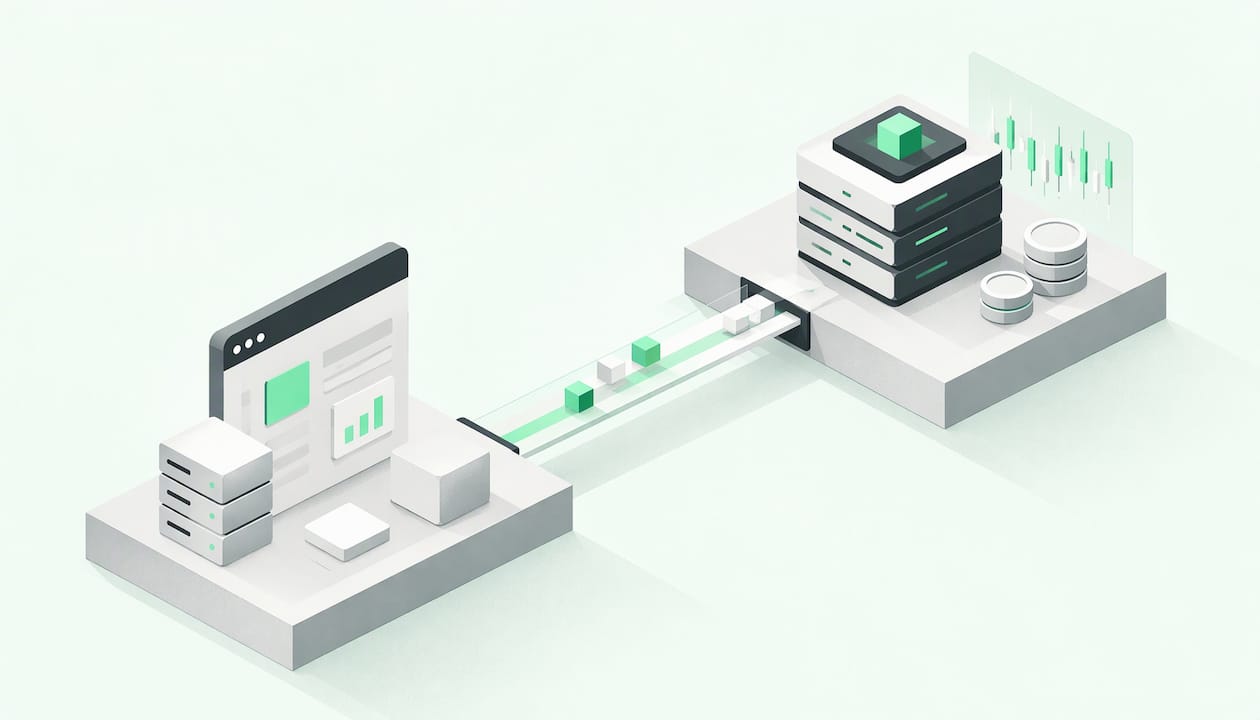
Stablecoin payroll means the employer funds payroll in dollars or another fiat currency, converts it to a dollar-pegged token such as USDC, and sends it to workers’ wallets in minutes instead of days. The payment is only one layer. The rest of the job is conversion, wallet security, tax reporting and a way for the worker to reach local currency. Done well, it gives international teams faster settlement and lower transfer friction. Done carelessly, it creates withholding errors and conversion costs that nobody priced in. This guide covers the mechanics, the cost formula, the main tax rules and a setup checklist for employers and workers.
What stablecoin payroll actually is
A stablecoin is a crypto token designed to hold a fixed value, usually one US dollar. USDC and USDT are the best-known examples. Payroll in stablecoins uses that token as the delivery vehicle for salary or contractor fees. The employer still calculates gross pay, deductions and taxes in the normal way. Only the last step changes: instead of a bank transfer, the net amount moves on a blockchain.
Three arrangements are common:
- Full stablecoin pay. The whole net amount is sent as tokens. This is most common for contractors and remote workers in countries where bank transfers are slow or expensive.
- Hybrid pay. A base share is paid by bank transfer and a share, chosen by the worker, in stablecoins.
- Stablecoin settlement, local payout. The employer or payroll platform moves value across borders in stablecoins, then pays workers in local currency. The worker may never see a token.
The third model is often the easiest to run in a regulated setting, because the worker’s experience does not change. For a deeper look at how companies structure these flows, see this guide to stablecoin business payments.
How a stablecoin salary payment works, step by step
- Fund in fiat. The employer holds dollars, euros or another currency in a bank or payment account and decides the payroll amount.
- Convert to stablecoins (on-ramp). An on-ramp is a service that turns fiat into crypto. The employer or its payroll platform buys USDC or another token. Here the first fee and the first exchange-rate spread appear.
- Choose the network. Tokens exist on several blockchains, and each has its own fees and speed. The sender and the receiving wallet must use the same network, or the funds can be lost.
- Send to verified wallet addresses. Each worker provides a wallet address. A good process confirms the address before the first payment, often with a small test transfer.
- Worker receives and chooses. The worker can hold the tokens, swap them, spend them by card, or cash out through an off-ramp, the reverse service that converts crypto back to fiat.
- Record and report. The employer records the dollar value at the time of payment for tax and accounting. This step is easy to forget and hard to rebuild later.
Settlement across the sending side, the network and the receiving side is the part where infrastructure matters. Businesses that do not want to build it themselves can use embedded on and off-ramps and a global settlements layer through an API. For the layers involved and their costs and risks, stablecoin payment infrastructure is explained in more detail.
Why employers and workers consider it
The case rests on a few practical points:
- Speed. Blockchain transfers can settle in minutes, at any hour, including weekends. Wires between countries can take days.
- Predictable value for the worker. A dollar-pegged token protects against local currency swings for workers in countries with unstable currencies, as long as the peg holds.
- Fewer intermediaries. Fewer correspondent banks in the chain generally means fewer places where fees are added and fewer failed payments.
- One payout rail for many countries. A company with contractors in a dozen countries can use one method instead of managing a dozen bank formats.
- Flexibility for the worker. A worker can hold part of the pay, spend it by card, or convert it when the exchange rate suits them.
These advantages are strongest for international teams, freelancers and remote workers. For a domestic team paid by ACH in the same country, the case is thinner, and a hybrid option at the worker’s request is usually the practical form. The cross-border payments overview shows what a cross-border crypto payment means in practice.
What it costs: the effective-cost formula
Headline claims such as “no wire fees” describe one line of the bill. The effective cost of a stablecoin salary payment is:
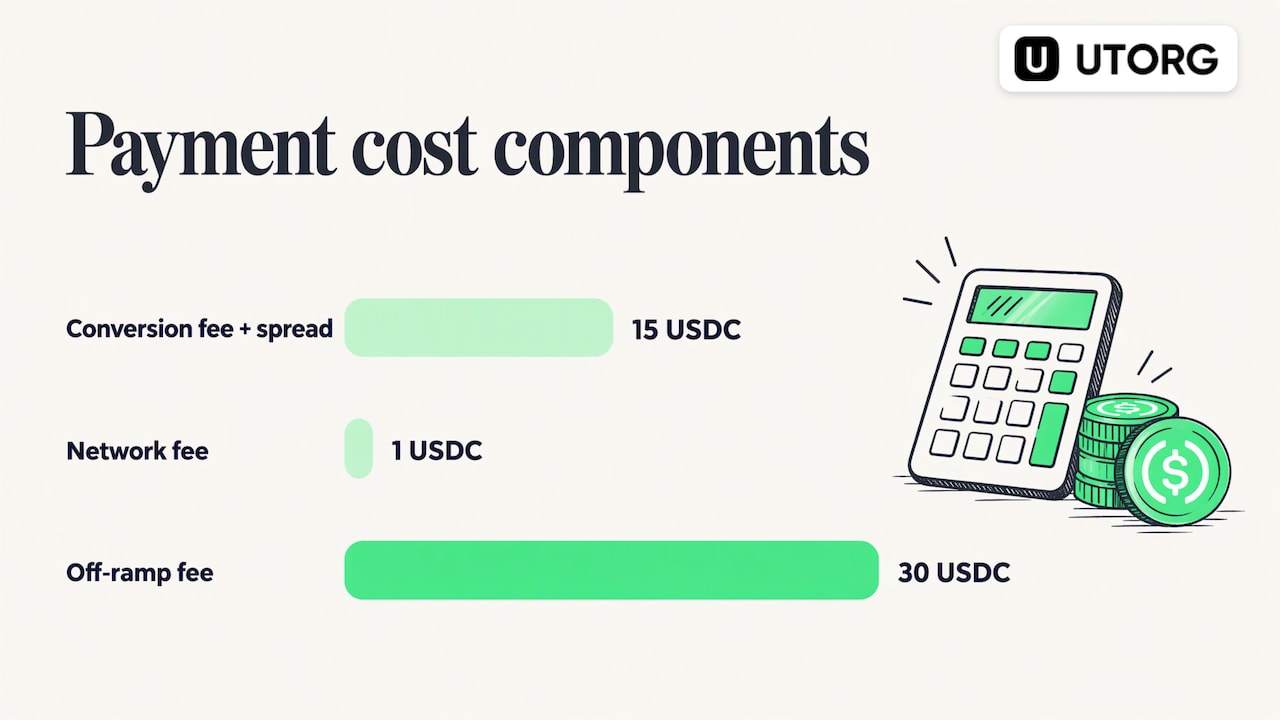
Total cost = on-ramp fee + on-ramp spread + network fee + off-ramp fee + off-ramp spread (or card FX markup)
Terms used here:
- Spread: the gap between the market price and the price you are actually given. It is often buried in the exchange rate rather than shown as a fee.
- Network fee: the blockchain charge for moving tokens. It varies by network and by congestion.
- FX markup: the margin added when a card or provider converts one currency to another.
The table shows where costs arise for each party. It lists categories, not prices, because they vary by provider, region and payment method.
Worked example (illustrative assumptions only, not Utorg prices). An employer pays a contractor 3,000 USDC. Suppose the employer’s conversion costs 0.5% in fees and spread (15 USDC), the network fee is the equivalent of 1 USDC, and the contractor’s off-ramp costs 1% (30 USDC). Total friction is 46 USDC, or about 1.5%. A wire might cost a flat $15 to $50 plus intermediary charges and a currency markup. Which one is cheaper depends on amounts, corridor and how the worker cashes out. The test is a quote for the whole path, from funding to local currency, rather than any single line.
Workers who spend rather than cash out can skip the off-ramp. A crypto card links tokens to everyday payments, and card fees then replace off-ramp fees. Stablecoin cards carry issuance and maintenance fees, so check the current schedule.
Tax and legal rules to settle before the first payment
Paying in stablecoins does not move payroll outside the existing rules. The rules differ by country, so pick the jurisdiction of the employer and the worker before choosing a structure.
United States
The IRS states in its digital asset FAQs (updated December 15, 2025) that the form of payment is immaterial to whether it counts as wages. Digital assets paid as wages are measured at fair market value in US dollars on the date of receipt, are subject to federal income tax withholding, FICA and FUTA, and are reported on Form W-2. Independent contractors paid in digital assets have self-employment income at the same dollar value, subject to self-employment tax.
The same FAQs say that paying for services with digital assets is a disposition. An employer that holds appreciated tokens and uses them to pay staff can therefore recognize a gain or loss. Converting fiat to a stablecoin right before payment keeps that difference small, but the record still matters. An IRS procedural update of March 10, 2026 confirms that stablecoins count as virtual currency, taxed as property, with W-2 reporting for employees and Form 1099-NEC for contractors above the reporting threshold. The IRS’s older Notice 2014-21 says the dollar value must be determined by converting at an exchange rate applied in a reasonable and consistent manner.
State wage laws and the federal minimum wage rules also govern the form in which wages may be paid, and some states require consent or a cash option. Employers should confirm the position with an employment lawyer or payroll adviser in the relevant state before moving any employee to token pay.
On the stablecoin side, the GENIUS Act was signed into law on July 18, 2025 as P.L. 119-27 and establishes a regime to regulate US payment stablecoins. Employers should check that the token they pay in comes from an issuer that fits this framework.
United Kingdom
HMRC’s Cryptoassets Manual states that cryptoassets received as employment income count as money’s worth and are subject to Income Tax and National Insurance contributions. The employer must account for tax and Class 1 contributions. HMRC’s non-cash pay guidance says the value must be added to earnings, PAYE and Class 1 contributions deducted through payroll, and the payment reported in a Full Payment Submission on or before the payment date.
European Union
The EU’s MiCA regulation sets rules for e-money tokens, the category that covers euro and dollar stablecoins from regulated issuers. According to the EUR-Lex summary, issuers must redeem tokens at face value on request and hold the funds in safe, low-risk assets in a separate account. The rules for these token issuers fully applied from 30 December 2024. Payroll and social security rules are national, so an EU employer still follows the law of the country where the worker is employed.
The common thread: dollar value on the payment date, withholding where the worker is an employee, and records. Contractor status, tax residency of the worker and local rules on how wages are paid decide the rest, which is why a tax adviser belongs in the setup.
Risks to price in
Depegging. A stablecoin can trade below its target value when confidence in its reserves breaks. In March 2023 USDC briefly lost its dollar peg after the failure of Silicon Valley Bank, as an academic study of the episode describes. For payroll, the practical protection is to convert quickly after receipt, or to pay out in a token whose reserves and redemption terms are clear and regulated.
Wrong address or wrong network. Blockchain transfers are generally irreversible. A mistyped address or a network mismatch can mean permanent loss. Verify addresses, send a small test amount first, and keep an approval step for changes to a worker’s address.
Wallet security. In a self-custody wallet, the worker holds the private keys, and losing the recovery phrase means losing access. Workers should follow a wallet security checklist: store the recovery phrase offline, enable device protection, and never share it. Employers using embedded wallets should look at the design of wallet infrastructure, including who controls keys.
Access to local currency. Receiving tokens is the easy part. The worker needs a reliable way to cash out or spend them locally. Off-ramp availability varies by country and payment method, so confirm it for each worker’s location before promising stablecoin pay.
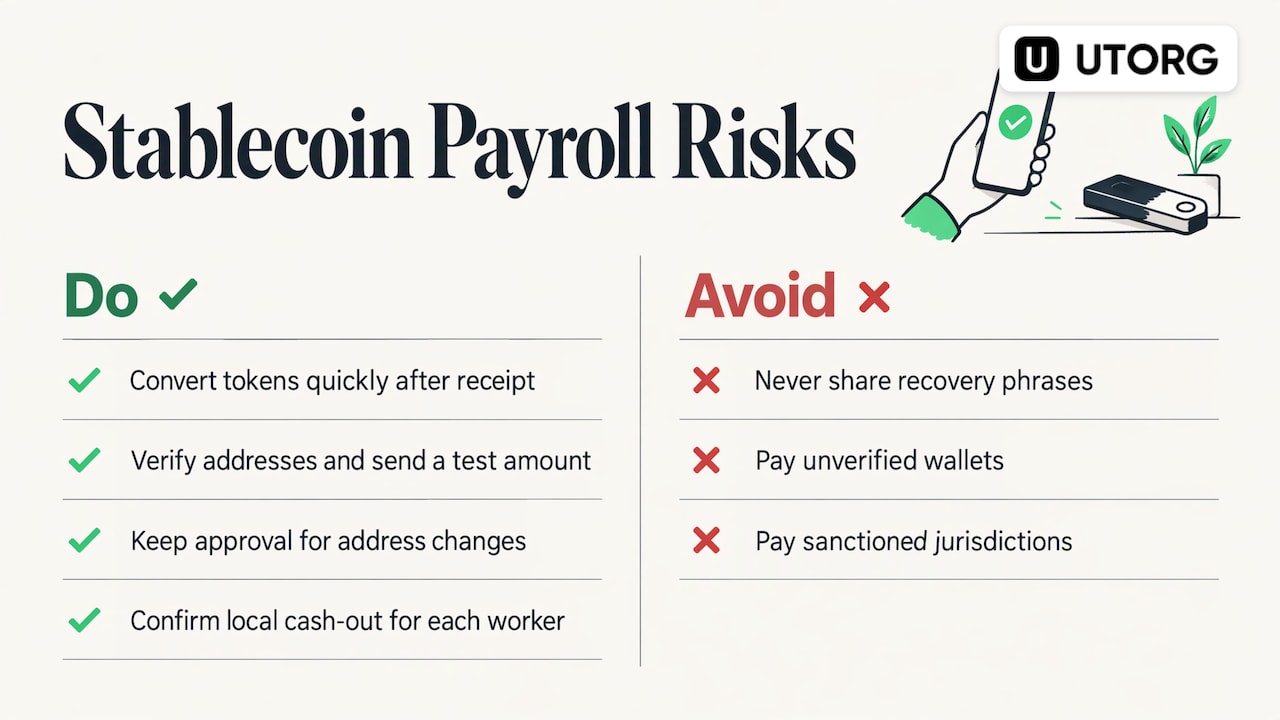
Compliance and KYC. Onboarding requires identity checks (KYC) and anti-money-laundering screening (AML). Payments to unverified wallets or sanctioned jurisdictions create exposure for the employer.
Setup checklist for employers
- Classify each worker as employee or contractor, and confirm tax residency.
- Get written worker consent to token pay, with the share and currency stated, and check state or national rules on the form of wages.
- Choose the token and network by issuer regulation, reserve terms and the worker’s cash-out options.
- Decide who pays network and conversion fees, and put it in the contract.
- Verify wallet addresses and test with a small transfer.
- Record the USD value at each payment date for W-2 or 1099-NEC reporting, or the local equivalent.
- Set a policy for payment errors and for a depeg event, such as same-day conversion.
Checklist for workers who receive stablecoin pay
- Confirm whether you are paid as an employee or contractor, and set aside money for taxes. In the US, the dollar value on the day you receive the tokens is your income, whatever you do with them later.
- Use a wallet you control and back up the recovery phrase offline.
- Share the correct network with the payer, not just the token name.
- Decide in advance how much to hold, spend or convert. Idle USDC can be put to work through an earn feature where available.
- Keep records of every receipt and every conversion.
How Utorg fits
For businesses, Utorg provides crypto infrastructure through APIs and white-label solutions: embedded fiat on and off-ramps, wallet infrastructure, global settlements and branded crypto card programs, with stablecoin support across blockchains and solutions designed for regulated environments. Companies can integrate one component, such as the on-ramp that funds payouts, or combine several into a broader wallet and payments offering. To discuss a payout or settlement flow, contact the sales team.

For the person being paid, Utapp by Utorg combines a self-custody wallet with a crypto card. Workers can buy, hold, swap and send crypto, earn on USDC through Earn, and spend with the card where supported, keeping control of their wallet keys. See the Utorg app and wallet or the Utorg Card.
Frequently Asked Questions
FAQ title
Can an employer legally pay salary in stablecoins?
In the US, the IRS treats wages paid in digital assets as taxable wages measured in USD, so withholding and W-2 reporting apply. Whether a particular state or country allows it depends on its wage-payment rules and the worker’s consent. Confirm this with an employment lawyer or payroll adviser before starting.
Is stablecoin salary taxed differently from normal pay?
The tax treatment follows the dollar value at the time of receipt, not the form of payment. Employees are taxed like any wage earner, and contractors owe self-employment tax in the US. In the UK, HMRC requires PAYE and National Insurance on cryptoassets paid as earnings.
How fast does stablecoin payroll settle?
The transfer itself typically takes minutes, at any time of day. Total time also depends on funding the employer’s account, converting fiat to tokens, and the worker’s cash-out method.
What are the main costs?
The costs are the on-ramp fee and spread, the network fee, and the worker’s off-ramp or card conversion cost. Add them together for the full path and compare that figure with your current wire or payroll provider quote.
What happens if a stablecoin loses its peg?
Workers holding the token can see its value fall until the peg recovers, as USDC did in March 2023. Converting soon after receipt and using tokens from regulated issuers reduces the exposure.
- IRS: Frequently asked questions on digital asset transactions
- IRS: SBSE procedural update, March 10, 2026
- IRS: Notice 2014-21
- Congress.gov CRS: GENIUS Act of 2025 overview
- HMRC Cryptoassets Manual CRYPTO21100
- GOV.UK: Paying employees in non-cash pay
- EUR-Lex: MiCA summary
- EUR-Lex: MiCA delegated regulation, 2024
- MDPI: Collapse of Silicon Valley Bank and USDC depegging