Decentralized Finance (DeFi): How It Works and Where to Start

Read time 7 min
TL;DR
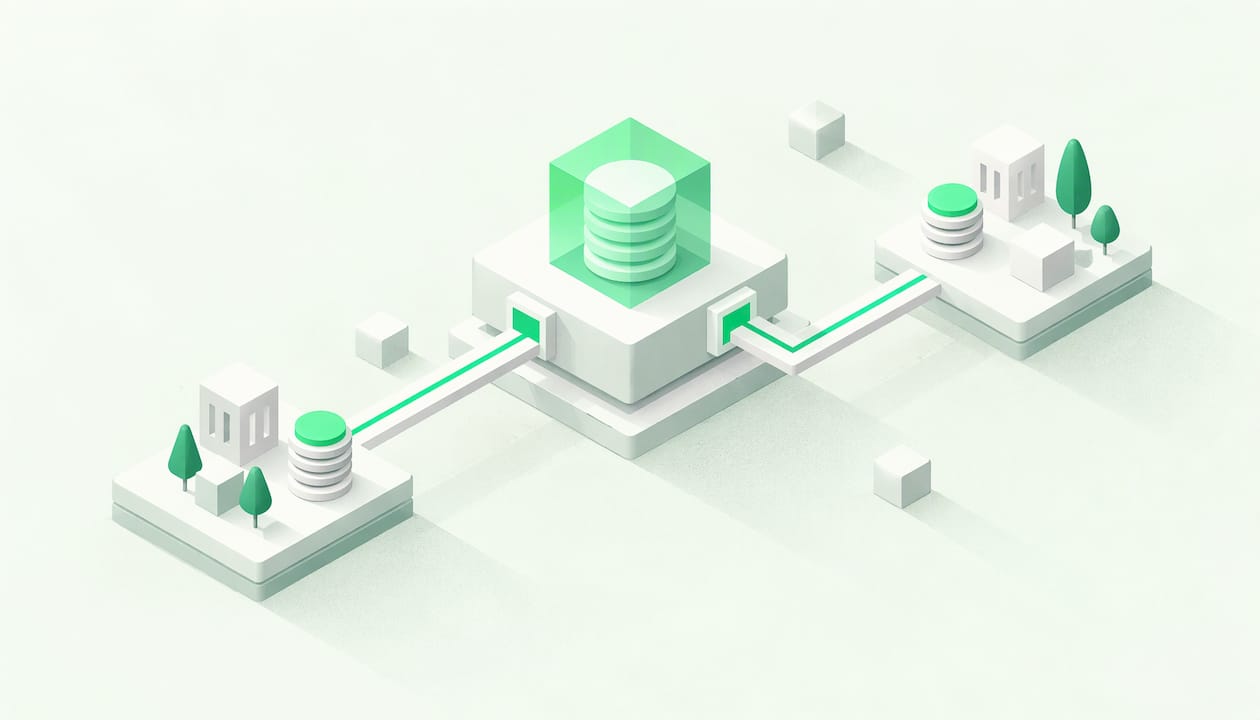
- DeFi replaces intermediaries with smart contracts: self-executing programs on a blockchain that carry out a transaction when set conditions are met.
- Your access depends on a wallet whose private keys you control. Lose the keys and nobody can recover the funds.
- Typical uses are lending and borrowing, trading on decentralized exchanges, staking and peer-to-peer insurance.
- Regulators name smart contract bugs, oracle failures, key loss and limited recourse as the main risks.
- Most people and businesses enter through a fiat on-ramp and a wallet, which is where Utorg fits.
Decentralized finance, or DeFi, is a set of financial services (lending, trading, earning, insurance) that run on public blockchains through smart contracts instead of through a bank or broker. To use it you need a self-custody wallet and some crypto, and Utorg provides both routes in: the Utapp wallet and card for individuals, and wallet, on-ramp and settlement infrastructure for businesses that want to connect their users to on-chain finance.
What decentralized finance means
The Congressional Research Service (April 2026) defines DeFi as financial activities and services facilitated by cryptocurrency and intended to run without traditional intermediaries. Public, permissionless blockchains and smart contracts take the place of the infrastructure that banks, brokers, exchanges and clearing houses normally provide.
Two words in that definition matter:
- Permissionless: anyone with compatible software and cryptocurrency can take part. There is no application or credit check.
- Smart contract: a program stored at a specific blockchain address that executes a transaction when predetermined criteria are met.
The Federal Reserve’s staff paper on DeFi describes the same idea: users invoke smart contracts directly, without a trusted central intermediary such as a bank.
How DeFi works: blockchain, smart contracts, wallets and oracles
A DeFi service has four working parts.
- The blockchain. In a public network the ledger is held by many unaffiliated computers (nodes) rather than one central server. All transactions are publicly visible on-chain, although the pseudonymous addresses can be hard to link to a real person.
- Smart contracts. A Bank of Canada working paper describes a layered design: a base blockchain layer, DeFi protocols deploying smart contracts on top, and applications above those that combine protocols and offer wallets to users.
- Wallets. Users hold crypto in self-custody (unhosted) wallets tied to blockchain addresses. A Wharton study separates non-custodial wallets, where you alone control the private keys, from custodial wallets, where a provider manages them.
- Oracles. A contract cannot see the outside world. Oracles query and verify external data, such as the price relationship between USDC and ether, and pass it to the contract. That is how a lending protocol can trigger an automatic margin call when prices move.
The Slovak central bank gives a simple example: a smart contract can release a borrowed crypto-asset and enforce repayment automatically, with no loan officer involved.
What you can do with DeFi
The National Bank of Slovakia lists four main uses:
Lending and borrowing
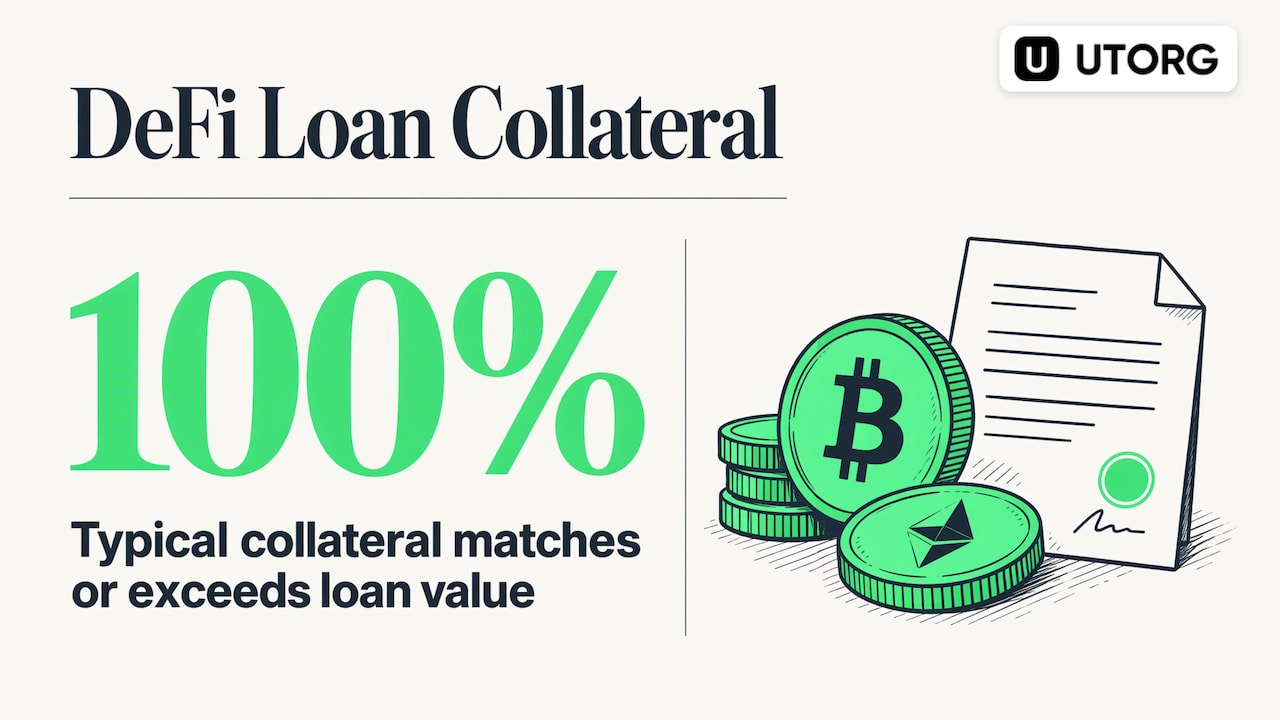
DeFi lending is over-collateralized. A borrower posts collateral in another cryptocurrency and needs no personal details or credit history. The trade-off for that openness is that collateral replaces the credit check. The Alabama Securities Commission notes that collateral is typically at least 100% of the loan value, which limits who can borrow.
Decentralized exchanges
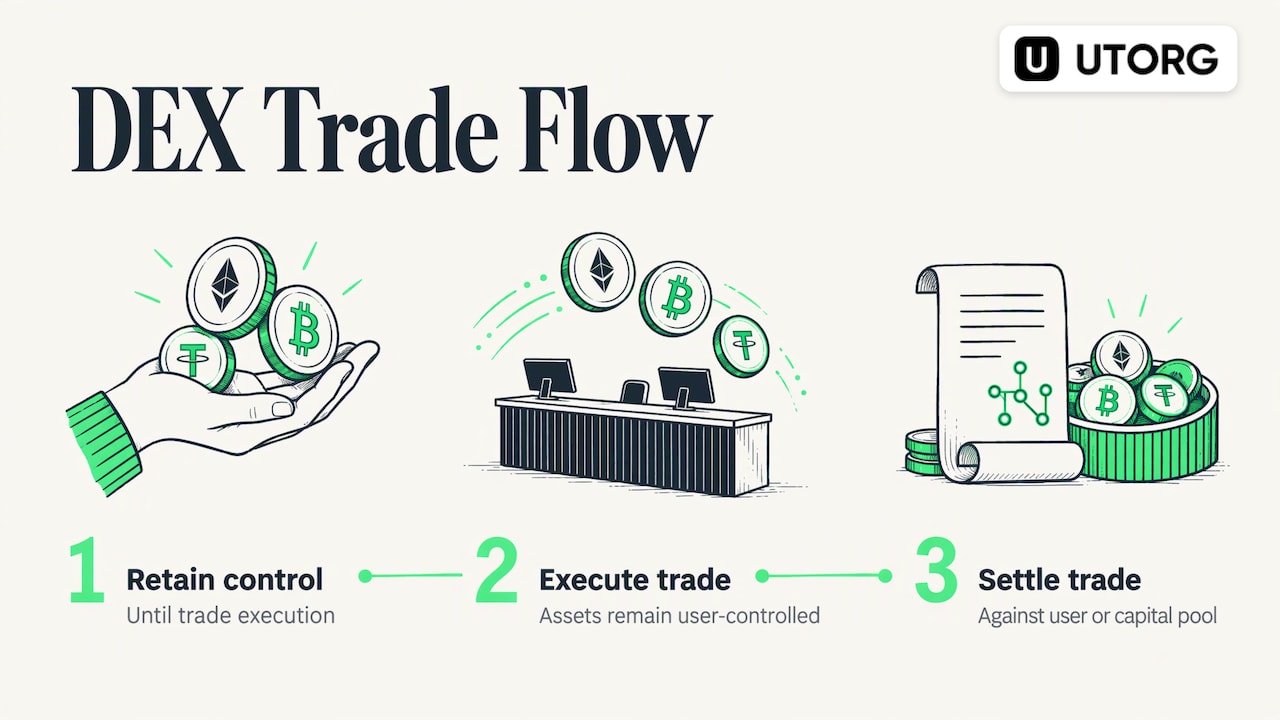
On a DEX you keep exclusive control of your assets until the trade executes, and a smart contract settles the trade against another user or a capital pool. If you want the full comparison with order-book exchanges, our guide to centralized and decentralized exchanges covers it, and how crypto exchanges work explains fees and order types.
Yield farming and liquidity provision
Yield farming means spreading assets across several DeFi activities at once, such as supplying liquidity for trading and lending. Liquidity providers receive LP tokens that act as receipts for fees, interest or the right to redeem the underlying assets.
How big is it?
CRS reported total value locked, the value parked in all DeFi protocols, at about $98 billion as of March 2026. The same report stresses that DeFi remains much smaller than traditional financial markets. TVL moves daily with token prices and deposits, so treat the figure as a snapshot for that month.
DeFi compared with traditional finance
CRS notes that DeFi eschews credit scores, financial thresholds and underwriting standards in favor of technology and collateral. Central banks and regulators also point to benefits: the Slovak regulator says DeFi can reduce transaction costs and support financial inclusion. For a primer on the money itself, see fiat versus crypto.
Risks to understand before you use DeFi
DeFi is open and self-directed, so the responsibility sits with you. Official bodies name these risks consistently.
- Smart contract vulnerabilities. The UK FCA’s consultation GC26/7 notes that code is often public, so flaws can be found and exploited, and contracts may be hard to pause, amend or reverse once deployed. It cites reported losses of more than US$12 billion through DeFi and bridge hacks since 2016.
- Key loss. The Alabama Securities Commission warns that losing a private key means losing access to funds with no way to recover it, and that DeFi has no consumer protections in place.
- Oracle failures. A contract acts on whatever data it receives, so bad price data produces bad outcomes. The FCA lists oracle failures among the main risks.
- Access-control exploits. IOSCO reports that attackers who compromise control points can alter balances, change contract parameters or bypass multi-signature protections.
- Unsustainable yield. Some products rely on continuous inflows to pay earlier users, a model the FSB, as summarized by IOSCO, calls unsustainable. A high advertised yield deserves a look at where it comes from.
- Network congestion. Public blockchains can experience delays or failed transactions.
- Unsettled regulation. CRS says DeFi’s treatment is still unsettled, including how anti-money-laundering rules apply where centralized and decentralized crypto meet. US readers should check current rules before using any protocol.
Practical habits follow from this: start with small amounts, back up your recovery phrase offline, and read our wallet security checklist before connecting a wallet to any protocol. This is general information, not investment or tax advice. For decisions about taxes or large sums, speak to a licensed financial or tax adviser.
How most people and businesses get into DeFi
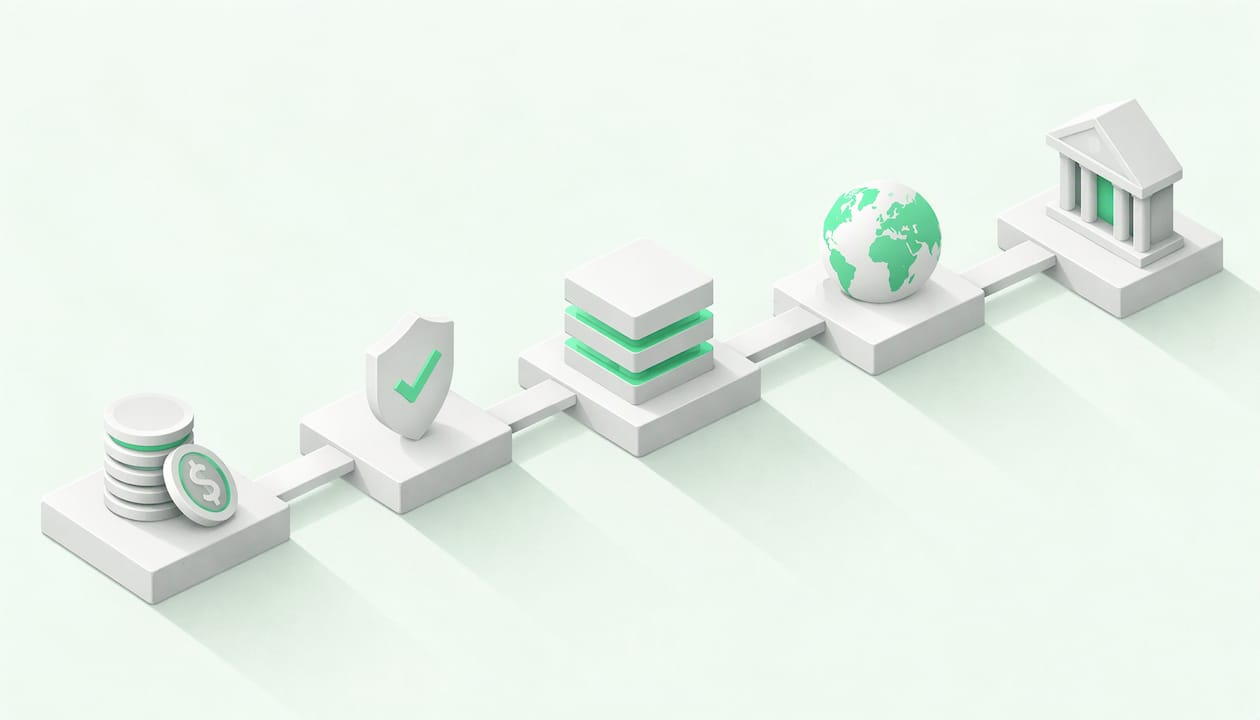
DeFi starts with crypto in a wallet you control, and most users have only dollars or euros in a bank account. The researchers behind the HKICR report observe that centralized crypto services commonly act as the entry point for users outside the DeFi ecosystem. In practice the path is:
- Convert fiat to crypto through an on-ramp (see how fiat-to-crypto conversion works).
- Hold it in a self-custody wallet.
- Move it to the protocol or product you chose.
- Move it back out through an off-ramp, or spend it.
For individuals
Utapp by Utorg combines a self-custody wallet, where you keep your own keys, with a crypto card. You can buy, hold, swap and send crypto, earn on USDC through Earn, and spend with the card where supported. That covers the steps around DeFi that people most often struggle with: getting funded, holding safely and using the balance in daily life. If you hold USDC and want it working, Earn is built for idle balances. Our guide to crypto debit cards shows what to look for in a card.
For businesses
Fintechs, banks, wallet providers, gaming platforms and international businesses often want their users to reach on-chain finance without building the plumbing. Utorg offers embedded on/off-ramps, wallet infrastructure, stablecoin settlements and white-label cards, available through APIs, individually or combined into one stack. Our overview of embedded wallet infrastructure explains how the pieces fit.
Utorg for your DeFi starting point
Whether you are one person funding a first wallet or a platform adding crypto for thousands of users, the first step is the same: a compliant way to turn fiat into crypto and a wallet that keeps control with the user.
Utapp gives individuals a self-custody wallet and crypto card in one app; see the Utorg app and wallet or buy crypto directly. Businesses can explore the Utorg infrastructure stack.
For more background, browse the DeFi and Web3 learning hub.
Frequently Asked Questions
FAQ title
What is decentralized finance in simple terms?
It is financial services such as lending, trading and earning that run on blockchains through smart contracts rather than through a bank. You interact from your own crypto wallet, and the code carries out the agreed terms automatically.
Is DeFi safe?
It carries real risks. Regulators cite smart contract flaws, key loss, oracle failures and limited recourse, and the Alabama Securities Commission notes there are no DeFi consumer protections. Start small, protect your keys and understand a product before depositing.
Do I need a bank account or credit check to use DeFi?
No. DeFi is permissionless, and borrowing relies on collateral instead of a credit history. You do need a wallet and crypto, and a fiat on-ramp is the usual way to get your first funds.
What is the difference between a custodial and a non-custodial wallet?
In a non-custodial wallet you alone hold the private keys and control the funds. In a custodial wallet a provider manages the keys for you. DeFi protocols are generally accessed from self-custody wallets.
- Congressional Research Service, An Overview of Decentralized Finance (DeFi), April 2026
- CRS report R48883, full text
- Federal Reserve FEDS Notes, Decentralized Finance
- National Bank of Slovakia, What is decentralized finance (DeFi)?
- Bank of Canada Staff Working Paper 2022-43
- Wharton, DeFi Beyond the Hype
- wifin Working Paper 18/2025, Decentralised Finance
- Alabama Securities Commission DeFi advisory, 2021
- FCA GC26/7, Decentralised Finance
- IOSCO FR14/23, DeFi policy recommendations
- HKICR applied research report, Decentralised Finance