The Foresight Game: What Happened at Utorg’s First Team Building Event
_11zon%20(3).jpeg)

Read time 8 min
A five-star hotel in Turkey for six days sounds like the perfect setup for our first team building event offsite. Good food, late nights, parties, an awards night with plenty of in-joke categories, different performances, unusual activities, and maybe even a little time by the pool. But our first team building at Utorg went in a pretty different direction.
Instead of switching off for a few days, we spent four of them looking ahead, questioning how we think, and figuring out where we might be heading as a company and as individuals. The main part of the trip was a four-day foresight game led by an ontology specialist.
Before the game even started
“The game is going to break you. Break you hard. You won’t like it. Just accept that you’re changing, and that you’ll go on to change everything around you.”
That’s how our founders opened the four-day session of the foresight game. They had already been through the same game themselves, so they knew exactly what they were warning us about.
But what exactly is a foresight game?
It’s a strategic session that takes a company out of its usual day-to-day routine and gives it several days to think about where it’s going, what’s working, and what needs to change. In our case, the session was led by a specialist in ontology (the study of how thinking itself is built).
The idea was to challenge the way we think, the way we work together, and the way we see our role in the company. Most importantly, it was about building ownership: understanding how our work connects to the bigger picture and taking responsibility for the result. And this is where the game started.
Day 1: facing reality as it is
You can talk a great game and still act completely differently. Management culture lives only in what you actually do.
It began with a distinction that ended up shaping the rest of the foresight game: what we say vs. what we actually do. An ontology specialist called them the content board and the activity board.

The interesting part is the gap between them. That’s where you start seeing what a team or a company is really like. That led us to a bigger question: how much of what we think we know about ourselves, our work, and our growth is actually true?
The rest of the day was about finding those gaps. We talked about how systems change, what gets in the way of growth, and why some of our biggest blind spots are the ones we don’t even know exist.
- Three modes of any system: functioning (just repeating yesterday), growth (more of the same, bigger numbers), and development (becoming something different).
- Four ways people quietly sabotage their own growth: checking out, watching from the sidelines, criticizing without participating, and chasing approval instead of results.
- Four types of knowledge: what we know, what we know we don’t know, what we don’t know we don’t know, and the unknowable.
Talking about system modes, it’s worth mentioning that the problem there is that day-to-day hierarchies make room for the first two,while operations eat the third. That’s where an idea of a meta headquarter comes in: a space set aside specifically for thinking. In a way, that’s exactly what this foresight session was.
By the end of the day, nobody had a neat list of answers. Instead, we had something more useful: a better understanding of what we didn’t know yet.
Day 2: from a student to a customer
We were optimizing for “the right answer” instead of for usefulness. The fix started with the step everyone skipped: agreeing on the task before touching it.
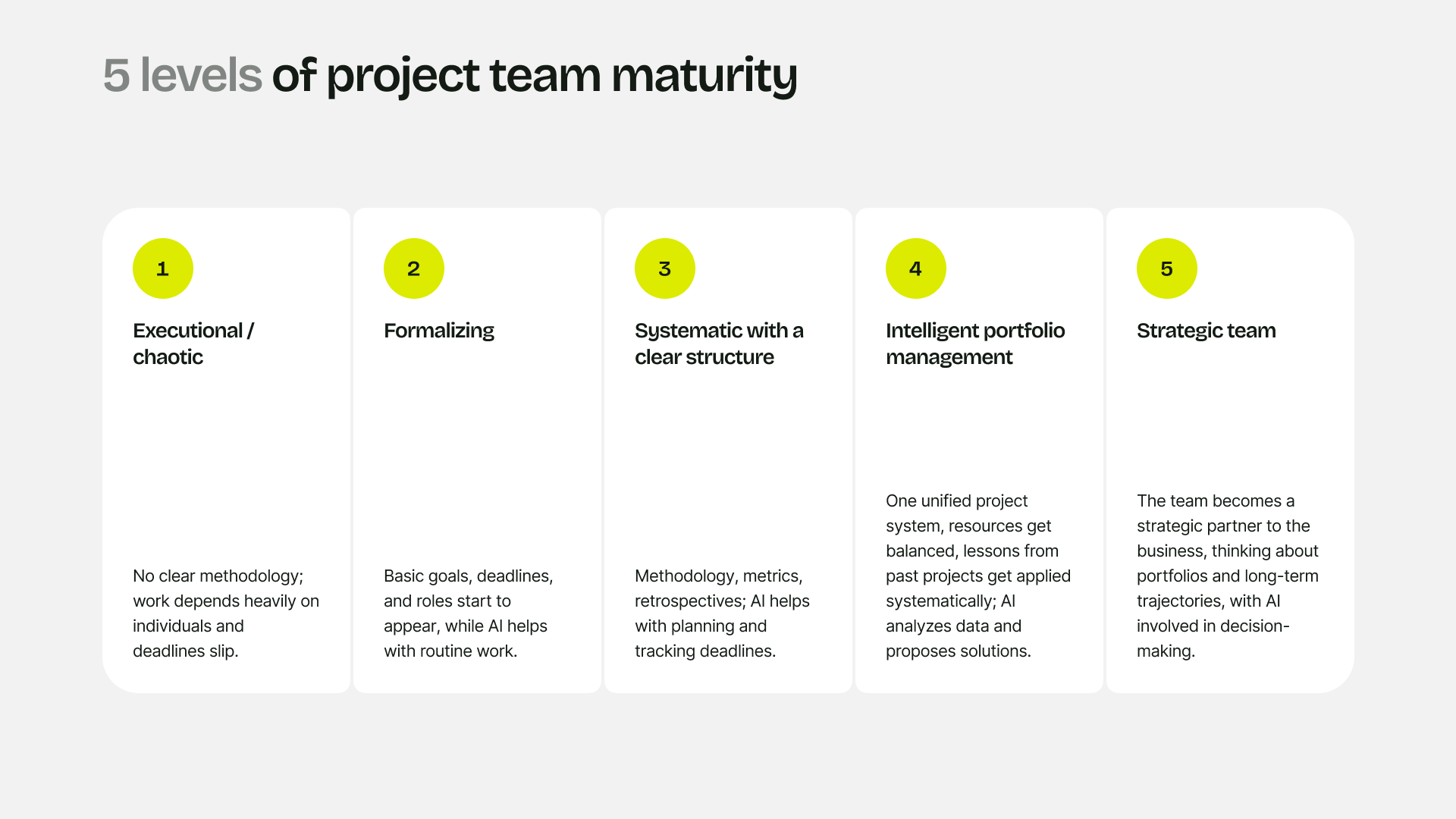
An ontology specialist split us into teams and gave us two assignments: break down 5 levels of prompt engineering and 5 levels of project team maturity, then present and defend our conclusions. Sounds straightforward, right? It wasn’t.
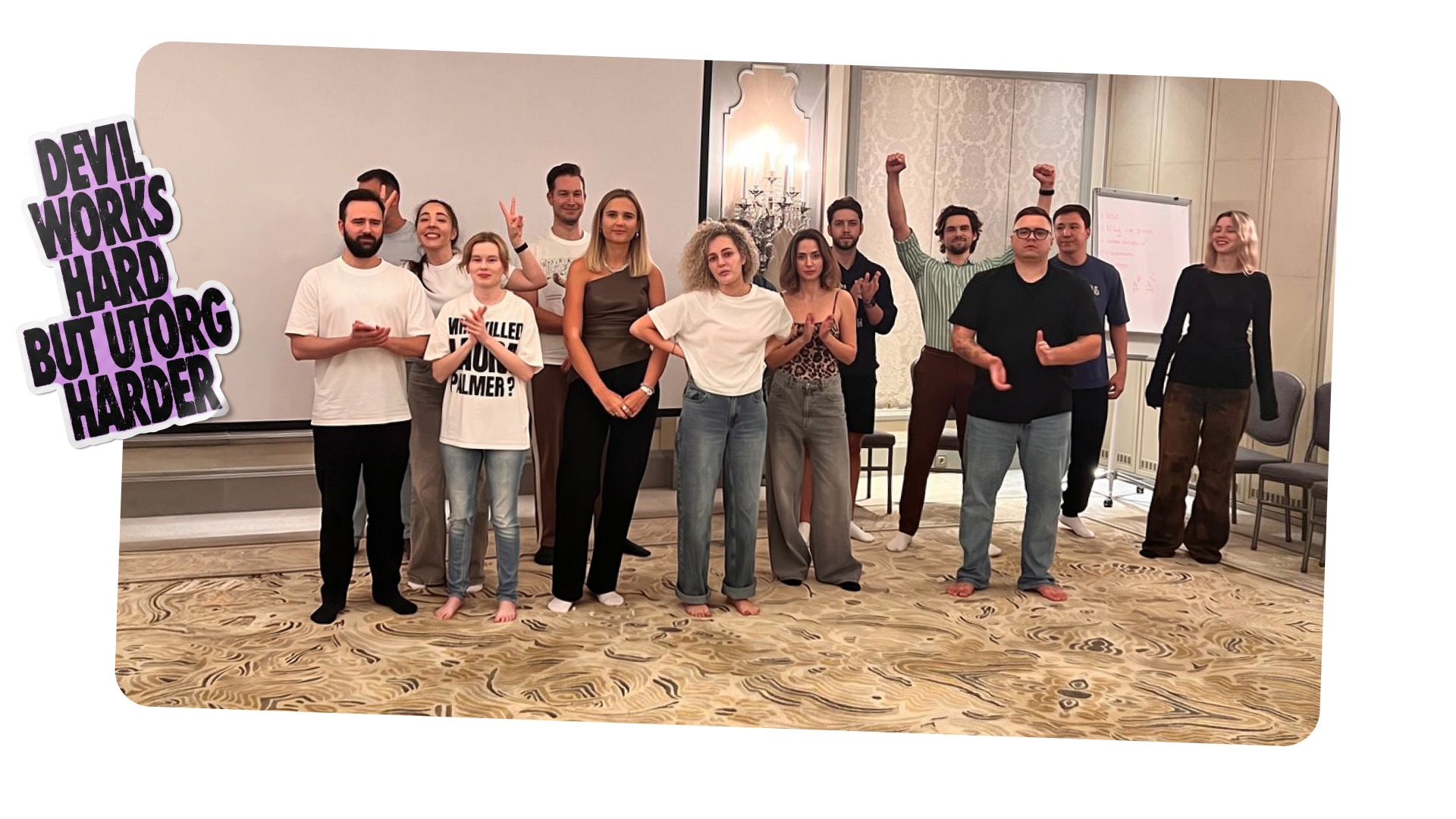
The issue started showing up as soon as the presentations began. Some teams had interpreted the assignment differently. Others started their logic with one idea and ended up somewhere completely different without noticing. We had essentially built different answers to the same question and only discovered it when we had to defend them.
We hadn’t agreed on what the task actually meant before getting started.
Most of us had slipped into the “student” position, doing the task to turn it in rather than to understand it. The shift came the moment we did the same task from the “customer” position, the one who sets the requirements and owns the result. Everything got deeper.
After walking through what went wrong, a specialist assembled the best pieces from our presentations into the final, correct version, the one the whole exercise had been building toward.

Day 3: learning to think together
A team could finally ask out loud, “are we even in the same step right now,” and the disagreement had somewhere to land instead of floating as tension.
By day three, we had learned how easily people can work on the same task while understanding it in completely different ways. But, how do you actually think together?
An ontology specialist showed that every folk tale and film runs on the same six beats, and so does thinking:
- situation analysis
- self determination
- goal setting
- problematization
- organizing the solution
- execution
Suddenly day two made sense. One person could still be analyzing the situation while another had already jumped to a solution. Both thought they were discussing the same thing, but they weren't at the same stage.
That also explained why teams rush into action. The hardest parts often come before it: figuring out where you stand and what the actual problem is. Skip those steps, and you’ll probably end up arguing about them later.
We also talked about the roles a team needs: someone to see the bigger picture, challenge the obvious answer, keep the discussion moving, and bring everyone back to the actual result.
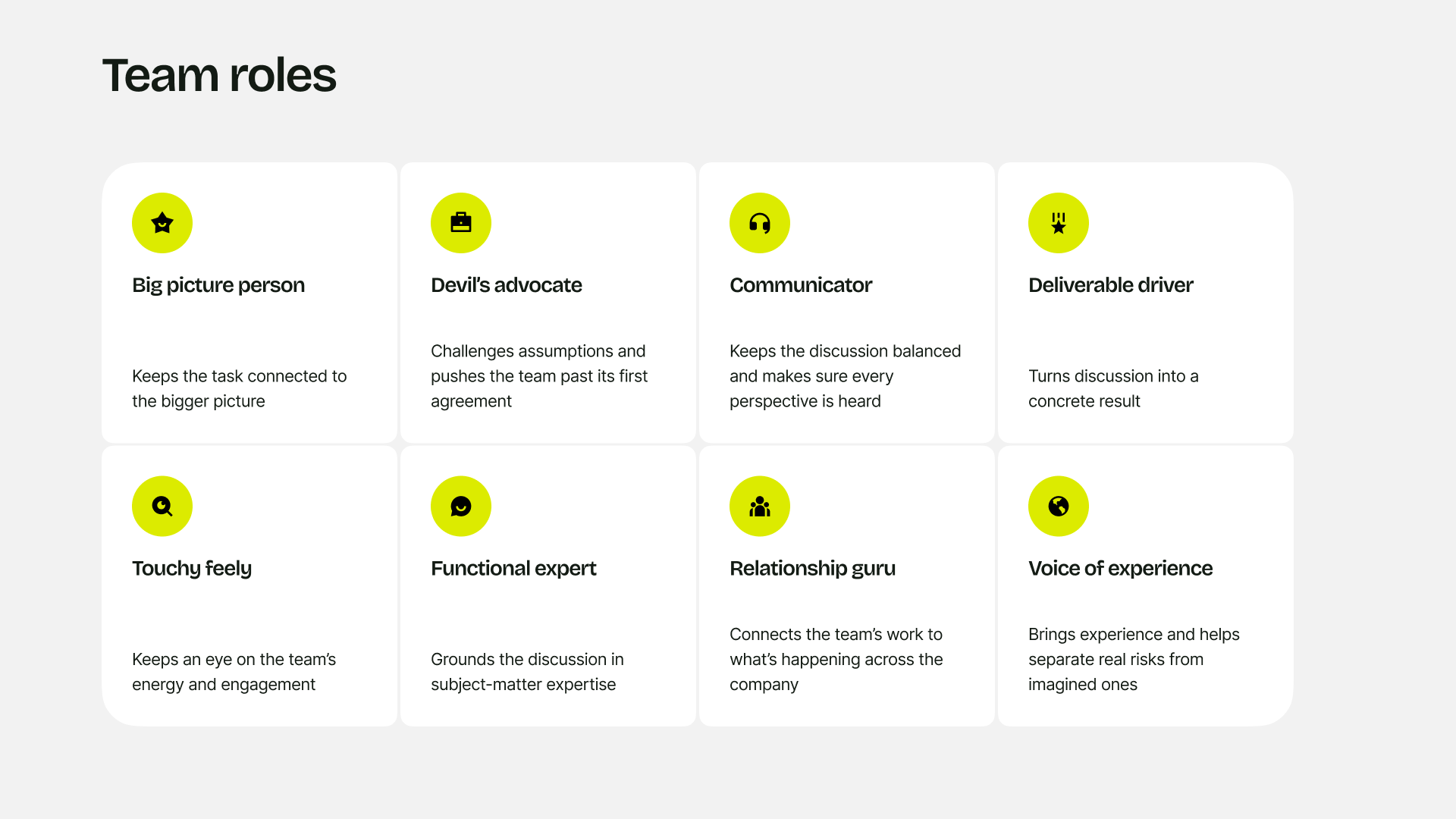
Nobody got a permanent role. The idea was to notice what's missing and step in. Maybe that was the main lesson of the day: a good team doesn't avoid friction, it knows how to use it.
Day 4: seeing the company as a whole
Everyone had a strong read on their own floor, and a guess about the rest of the building.
Most of us understood our own department pretty well (what it does, where things get stuck, and what needs to improve). But seeing how all those pieces connect was a different story.
An ontology specialist walked us through how companies evolve depending on what they manage: from individual tasks and processes to the business as a whole and, eventually, their position in the market.
When a company starts managing something new, the old structure may no longer work. Growth isn’t always about adding another process or hiring more people. Sometimes, it means rethinking the product, the business model, or the way the entire company is organized.
Four types of organizations
- Entrepreneurial (built around managing individual tasks and assignments).
- Mechanistic (focused on building and managing repeatable processes).
- Professional (optimizes those processes and looks for ways to improve their efficiency).
- Innovative (manages the company’s position in the market and adapts the business around new opportunities).
By the end of the final day of the foresight game, we had the bigger picture we’d been missing since the start.
What came out of the foresight game
Our founder had promised the game would break us, and that the only way through was to accept it. He wasn’t exaggerating. Nobody was screaming into a bathroom mirror, but by day four, most of us had quietly let go of the version of ourselves that walked in on day one.
The true value of this four-day strategic session will unfold over the coming year, but immediate changes have already taken root:
- we walked away with a genuinely deeper read on what’s happening inside the company, and a much stronger sense of ownership;
- we stopped treating the old way of working as the default;
- we created a meta headquarter and started developing new projects.
All of those things only exist because something broke first, and that’s the point the founder was making from the very start.
The party
Four days of rebuilding our heads. One night to lose them a little. Dinner started formally and stayed that way for about ten minutes. Then the dancers took the floor, the singers followed, and the room found a second gear.

Contests all night, including one where we tried to guess which colleague a story was about.
Then the awards. None of them make sense outside that room, which is exactly why we love them.
Our CEO of Payments got voted company mascot. Fully democratic.
Our front-end lead was crowned the company crush.
And our Chief Legal & Compliance Officer took “shortest call of the year.” Said with love: this is a man who gives every call his full attention, and then some. We handed him the award as a gentle hint. He'll probably want to book a call to discuss it.
We ended the night with the founders. After putting us through four days of controlled demolition, we hit them with a thank-you they didn’t see coming: a suitcase, with something inside. What it was exactly stayed in that room. Their faces did not.
That was the real point of the night. Not the trophies. Just all of us in one place after everything, still glad we do this together.
Why we’re telling you any of this
Because it’s maybe the most honest thing we can say about Utorg: here, people’s thinking gets the same serious investment as the product. We can write all we want about regulation, infrastructure, and the card. But behind all of it are people who weren’t “motivated” with a stick, but helped to see why they do what they do.
This is the kind of company we’re building, and if you’re interested in becoming a part of it, you can check our open roles here.
.png)